

For most UK residential and small-to-medium developments, the main build contract types developers use are: lump sum (fixed price), cost-plus, time and materials (T&M), unit price, guaranteed maximum price (GMP), design and build, integrated project delivery (IPD), and subcontractor agreements. According to Procore, each suits different project scopes and risk appetites, with lump sum best for a well-defined scope and cost-plus better suited to evolving or incomplete designs.
For most UK residential and small-to-medium developer projects, shortlist lump sum, GMP, and design and build first. Which of those three you choose depends on how complete your design is and how much cost risk you are prepared to carry.
- Lump sum gives you price certainty and shifts cost risk to the contractor, provided your scope is fully defined before you sign.
- GMP caps your exposure while preserving some flexibility, and shared-savings clauses can align the contractor’s incentives with yours.
- Design and build hands a single point of responsibility to the contractor, accelerating procurement when design is still at an early stage.
Your immediate next step is to appoint a specialist construction solicitor, a quantity surveyor (QS), and a client-side contract administrator before you shortlist contractors. These three advisers will save you far more than their combined fees.
Key takeaways
Choosing the right build contract type is the single most consequential pre-construction decision a developer makes, because it determines who pays for overruns, who controls design, and how disputes are resolved.
| Point | Details |
|---|---|
| Match contract type to design stage | Lump sum requires complete design; GMP suits near-complete design; cost-plus suits early or evolving scope. |
| Use GMP with gain-share on medium schemes | A GMP cap with a shared-savings clause aligns contractor incentives with your development appraisal. |
| Standard forms reduce interpretation risk | JCT suits most UK building works; NEC suits programme-driven projects; FIDIC applies to major infrastructure. |
| Negotiate clauses before signing | Scope schedule, variation procedure, LDs, retention, bonds, and collateral warranties materially affect your risk. |
| Ajcandsonbuilders for Liverpool schemes | Ajcandsonbuilders delivers early packages, structural works, and full residential projects across Liverpool and Merseyside. |
Table of Contents
- How do the main contract types compare at a glance?
- What each contract type means for your project in practice
- Which standard UK contract forms should you consider?
- How do you choose the right contract type for your project?
- Which contract clauses should you negotiate before signing?
- How do procurement routes align with contract types?
- A practical pre-contract checklist for residential developers
- A developer’s perspective on choosing the right contract
- Ajcandsonbuilders: local delivery for Liverpool and Merseyside developers
- Useful primary sources and further reading
- Sources
How do the main contract types compare at a glance?
The dimensions that matter most when choosing a construction agreement are: who carries cost and design risk, how much price certainty you get, which project types and sizes each suits, where design responsibility sits, how well the contract handles changes, and how much administration it demands. Ironclad’s overview of construction contract types confirms that hybrids are common in practice, so treat the matrix below as a starting point rather than a rigid rulebook.
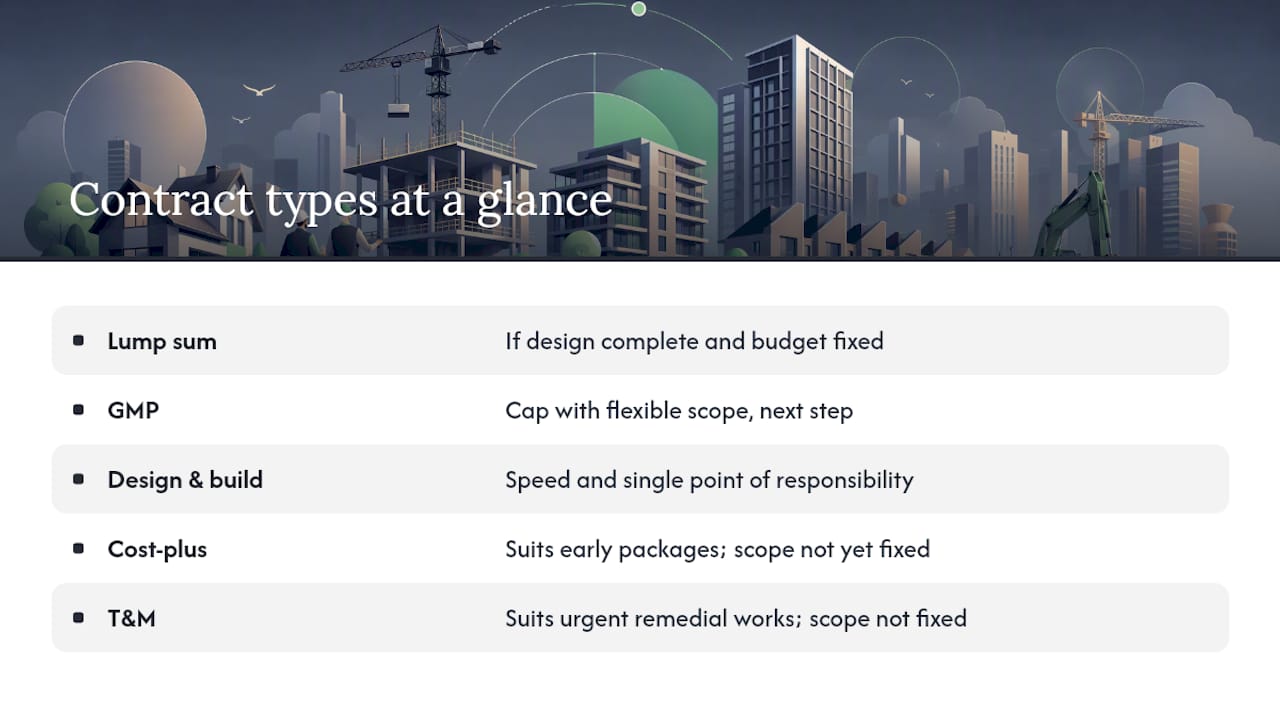
Reading the matrix: if your design is complete and your budget is fixed, lump sum is the natural starting point. If you need a cap but your scope has some flexibility, GMP is the next step. If you want speed and a single point of responsibility, design and build is the practical choice. Cost-plus and T&M suit early packages or urgent remedial works where scope cannot yet be fixed.
What each contract type means for your project in practice
Understanding the mechanics of each type, not just the label, is what separates developers who control their projects from those who are controlled by them. Autodesk’s guide to construction contract types provides a useful comparative framework across eight common forms; the notes below add the UK developer lens.
Lump sum (stipulated sum)
The contractor agrees a single fixed price for a defined scope. Cost overruns are the contractor’s problem; scope changes are yours. Payment is typically made against agreed milestones or valuations tied to the programme.
Risk: Contractor carries cost risk. Client carries scope-change risk.
Pricing: Fixed at tender; variations priced separately against a schedule of rates or agreed daywork.
Best for: Small custom housing terraces, single-dwelling extensions, well-specified refurbishments.
Clauses to check first: Scope schedule (must be exhaustive), variation procedure, liquidated damages (LDs), retention mechanics, and insurance obligations.
Pros: Price certainty, straightforward administration, easy to compare tenders.
Cons: Contractors price in risk contingency; any design gap becomes a variation claim.
Cost-plus (cost-reimbursable)
The client pays the contractor’s actual costs plus an agreed fee, either a fixed sum or a percentage. Transparency is the trade-off for certainty: you see every invoice, but your final cost is unknown until practical completion.
Risk: Client carries cost risk almost entirely.
Pricing: Actual labour, plant, and materials plus fee; open-book reporting is standard.
Best for: Structural remediation with unknown extent, early enabling packages, projects starting before design is finalised.
Clauses to check first: Definition of allowable costs, fee structure, audit rights, not-to-exceed (NTE) cap, and reporting frequency.
Pros: Flexibility, speed of start, transparency.
Cons: No price certainty; requires active client-side cost management.
Time and materials (T&M)
Similar to cost-plus but typically used for shorter, smaller packages. The client pays agreed hourly or daily rates for labour plus the cost of materials. T&M without a not-to-exceed cap is one of the most common sources of budget overrun on small developer projects.
Risk: Client carries cost risk.
Pricing: Agreed rate card plus materials at cost or with a mark-up.
Best for: Urgent repairs, small investigative works, short-duration packages.
Clauses to check first: Rate schedule, materials mark-up, NTE cap, and approval thresholds for additional spend.
Pros: Fast to mobilise, simple for small packages.
Cons: No cost ceiling without an NTE; incentivises slow working.
Unit price
The contractor prices a schedule of rates per measurable unit (per cubic metre of excavation, per linear metre of blockwork). The final sum depends on actual quantities measured on completion. Common in civil engineering and infrastructure but less so in residential building.
Risk: Contractor carries unit-rate risk; client carries quantity risk.
Pricing: Agreed rates applied to measured quantities.
Best for: Infrastructure packages, groundworks with uncertain volumes, measured-term maintenance contracts.
Clauses to check first: Measurement rules, re-measurement triggers, variation to rates if quantities change significantly.
Guaranteed maximum price (GMP)
A GMP contract sets a ceiling on what the client will pay. The contractor delivers within that cap; any savings below the GMP can be shared between client and contractor under a gain-share mechanism. This is one of the most developer-friendly structures for medium-to-large residential schemes where design is near-complete but some scope uncertainty remains.
Risk: Contractor carries cost risk up to the GMP; client carries risk above it only if scope changes.
Pricing: Open-book cost-plus up to the cap; gain-share on savings.
Best for: Multi-unit build-to-rent blocks, medium residential schemes, projects where early contractor involvement is desirable.
Clauses to check first: Definition of GMP scope, change-order procedure (what triggers a GMP revision), gain-share split, audit rights, and how the GMP is reconciled at completion.
Pros: Cost certainty with upside potential; aligns contractor incentives.
Cons: Requires robust scope definition to set the GMP; heavier administration than lump sum.
Design and build (D&B)
The contractor takes responsibility for both design and construction under a single contract. The client provides an employer’s requirements document; the contractor produces a contractor’s proposals. Single point of responsibility is the headline benefit, but design quality can suffer if the employer’s requirements are not drafted with sufficient precision.

Risk: Contractor carries cost and design risk.
Pricing: Usually a lump sum against the contractor’s proposals.
Best for: Fast-track residential schemes, commercial-to-residential conversions, projects where the client has limited design-management resource.
Clauses to check first: Employer’s requirements (must be detailed), contractor’s proposals (check for gaps), design liability and PI insurance, collateral warranties from key subcontractors, and novation of consultants.
Pros: Speed, single accountability, reduced client design-management burden.
Cons: Less client control over design detail; employer’s requirements must be thorough.
Integrated project delivery (IPD)
IPD brings the client, main contractor, and key subcontractors into a single multi-party agreement with shared risk and reward. All parties contribute to design and delivery; profit is pooled and distributed against agreed performance targets. IPD suits complex, multi-discipline projects where traditional adversarial contracting would create coordination failures.
Risk: Shared across all signatories.
Pricing: Pooled cost model with shared incentive.
Best for: Large mixed-use schemes, complex M&E-intensive projects, public-sector frameworks.
Clauses to check first: Risk-pool structure, decision-making governance, exit provisions, and IP ownership.
Pros: Aligns all parties; reduces adversarial behaviour; suits complex projects.
Cons: Heavy administration; requires sophisticated parties; rarely used on small residential schemes.
Subcontractor agreements
Every main contract generates a chain of subcontracts. The subcontract should mirror the main contract’s risk allocation, payment terms, and programme obligations. Back-to-back subcontracts protect the developer indirectly by ensuring the main contractor cannot pass liability gaps down the chain.

Risk: Mirrors main contract.
Pricing: Mirrors main contract (lump sum, cost-plus, or T&M depending on the package).
Best for: All trade packages under any main form.
Clauses to check first: Pay-when-paid provisions (restricted under the Housing Grants, Construction and Regeneration Act 1996), statutory payment obligations, back-to-back obligations, and collateral warranty obligations.
Practical developer scenarios:
- Small custom housing terrace (3–4 units, full planning and detailed design in place): lump sum JCT Minor Works or Intermediate Contract.
- Multi-unit build-to-rent block (20–50 units, RIBA Stage 3 design): GMP under JCT Standard Building Contract with Quantities, with gain-share clause.
- Structural remediation (extent unknown until opening up): cost-plus with NTE and weekly cost reporting.
- Fast-track commercial-to-residential conversion: design and build under JCT Design and Build Contract.
Which standard UK contract forms should you consider?
Standard forms matter because they carry decades of case law, established administration procedures, and recognised dispute-resolution mechanisms. Drafting a bespoke contract from scratch is rarely worth the cost unless your project is genuinely unusual.
JCT (Joint Contracts Tribunal)
JCT is the long-standing standard for building works in the UK and the form most residential and commercial developers will encounter. The suite covers a wide range of project types and sizes:
- Minor Works Building Contract (MW): suited to straightforward, low-value works where the client supplies the design.
- Intermediate Building Contract (IC): for medium-complexity projects with named subcontractors.
- Standard Building Contract (SBC): the workhorse for larger projects; available with or without quantities.
- Design and Build Contract (DB): for projects where the contractor takes design responsibility.
- Management Building Contract (MC): for management contracting procurement routes.
JCT forms are widely understood by UK contractors, solicitors, and QSs, which reduces the risk of misinterpretation. The administration procedures, payment notice requirements, and adjudication provisions are well-tested in the courts.
NEC (New Engineering Contract)
NEC4 is the current edition of the NEC suite. Where JCT is document-heavy and retrospective in its approach to risk, NEC is designed to be proactive: it requires early warnings, a live risk register, and regular programme updates. NEC is often chosen for public-sector and infrastructure projects, and increasingly for private residential schemes where programme certainty and active contract management are priorities.
NEC’s six main options (A through F) map broadly onto the contract types discussed above: Option A is a priced contract with activity schedule (similar to lump sum); Option C is a target cost contract with activity schedule (similar to GMP); Option E is a cost-reimbursable contract (similar to cost-plus).
Key insight: NEC’s early-warning mechanism requires both parties to flag risks as soon as they are identified, not after they have crystallised into claims. For developers managing tight programmes on residential schemes, this single feature can prevent the kind of late-stage variation disputes that derail completions.
FIDIC
FIDIC is the international standard-form family, most commonly encountered on major infrastructure, cross-border, or finance-driven projects. UK residential developers are unlikely to use FIDIC directly, but those working on large-scale infrastructure, public-private partnerships, or internationally financed schemes should consider it early. The FIDIC Red Book (Conditions of Contract for Construction) is the most widely used form for employer-designed works; the Yellow Book covers plant and design-build.
Bespoke and heavily amended forms
Some developers and their solicitors amend standard forms extensively, or draft bespoke contracts for specific projects. Heavy amendment carries real risk: it creates interpretation uncertainty, reduces the value of established case law, and can make the contract harder to administer. Where amendments are necessary, keep them targeted and ensure both parties’ legal teams review them carefully.
Pro Tip: Ask your solicitor to produce a contract amendment schedule that lists every departure from the standard form in one document. This makes the contract easier to administer and reduces the chance of a clause being overlooked during a dispute.
How do you choose the right contract type for your project?
Work through this checklist before you shortlist contractors or instruct a solicitor to draft heads of terms.
- Assess design completeness. Is your design at RIBA Stage 4 (technical design) or beyond? If yes, lump sum is viable. If you are at Stage 2 or 3, consider GMP or design and build. If design has barely started, cost-plus or T&M with an NTE is the safer route.
- Define your budget certainty requirement. Do you have a fixed development appraisal that cannot absorb overruns? If so, lump sum or GMP is non-negotiable. If you have contingency headroom and want to start early, cost-plus is acceptable for early packages.
- Assess programme urgency. Is there a planning condition expiry, a funding drawdown deadline, or a sales launch date driving your programme? Fast-track procurement usually means design and build or two-stage procurement with early packages under cost-plus.
- Evaluate project complexity and M&E intensity. High M&E content (apartments with communal systems, commercial fit-outs) increases the risk of scope gaps in a lump sum. Consider GMP or design and build with a detailed employer’s requirements document.
- Assess your procurement resources. Do you have an in-house project manager or contract administrator? If not, design and build reduces your administration burden but reduces your design control.
- Identify your appetite for change risk. If you expect the scope to evolve (phased residential schemes, live-site refurbishments), a rigid lump sum will generate variation claims. GMP or cost-plus with NTE gives you more room to manage change without adversarial pricing.
Questions to ask your advisers:
- QS: “What is the realistic cost range for this scope at current tender prices, and which contract type gives us the best cost certainty at this stage of design?”
- Solicitor: “Which standard form is most appropriate, and what amendments do we need to protect our position on design liability, payment, and dispute resolution?”
- Contract administrator: “What administration resource will this contract type require from us, and do we have it?”
Documents to have ready before seeking advice:
- Planning permission and conditions
- Existing surveys (structural, topographical, ground investigation)
- Current design drawings and specification (however incomplete)
- Development appraisal and contingency budget
- Programme milestones and key dates
Red flags that suggest the wrong contract type:
- Using a lump sum when the design is incomplete: every gap becomes a variation claim.
- Using T&M without an NTE cap: no ceiling on cost.
- Using design and build with a vague employer’s requirements document: the contractor will fill the gaps in their favour.
- Using cost-plus without audit rights and agreed cost definitions: allowable costs can expand silently.
Decision flow:
- Design complete → lump sum
- Design near-complete, want a cost cap → GMP
- Fast-track, single point of responsibility → design and build
- Unknown scope, early packages → cost-plus or T&M with NTE
Which contract clauses should you negotiate before signing?
The contract type sets the framework; the individual clauses determine whether that framework protects you. Ironclad’s analysis of construction contract types identifies variation control, payment mechanics, and dispute resolution as the clauses that most materially affect cost, cashflow, and programme. Here is what to focus on.
- Scope and scope exclusions. The scope schedule must be exhaustive. Any ambiguity will be read against you. Ask the contractor to confirm in writing what is excluded, not just what is included.
- Variation and change control procedure. Agree a written instruction requirement before any variation is carried out. Oral instructions are a common source of disputed claims. Specify the pricing mechanism for variations (schedule of rates, daywork, or agreed lump sum per instruction).
- Payment terms and milestones. Under the Housing Grants, Construction and Regeneration Act 1996, contractors have statutory rights to interim payments and adjudication. Agree milestone-based payment schedules that reflect actual progress, not arbitrary calendar dates.
- Retention and release. Standard retention is typically 3–5% of the contract sum, held until practical completion and then halved until the defects liability period expires. Negotiate the retention percentage and the defects liability period length before signing.
- Bonds and parent company guarantees. For contracts above a material threshold, require a performance bond (typically 10% of the contract sum) from a recognised surety. For contractors without strong balance sheets, a parent company guarantee is an alternative.
- Insurance obligations. Specify who maintains contractor’s all-risk (CAR) insurance, public liability, and professional indemnity (for design and build). Check that the policy limits are adequate for your project value.
- Collateral warranties. If you are developing for sale or funding, your funder and future purchasers will require collateral warranties from the main contractor and key subcontractors. Agree the warranty form and the list of warranted parties before contract execution.
- Liquidated damages (LDs). LDs must be a genuine pre-estimate of your loss from late completion, not a penalty. Set them at a level you can justify (lost rental income, holding costs, sales delay costs) and ensure the contractor has reviewed and accepted them.
- Extension of time (EOT). Understand which events entitle the contractor to an EOT (and therefore relieve them of LD liability) and which do not. Neutral events (exceptionally adverse weather, statutory undertakers’ delays) typically give time but not money; employer-risk events give both.
- Dispute resolution and adjudication. Under the Housing Grants, Construction and Regeneration Act 1996, either party has the right to refer a dispute to adjudication at any time. Agree the adjudication rules (TeCSA, RICS, or CIArb) in the contract rather than relying on the Scheme for Construction Contracts.
Practical negotiation tactics:
- Use a not-to-exceed cap on cost-plus and T&M contracts as a commercial discipline, even when the contractor resists.
- Agree staged retention release tied to specific defect-rectification milestones rather than a single end-of-defects-period release.
- For GMP contracts, negotiate a gain-share split (typically 50:50 or 60:40 in the client’s favour) to incentivise the contractor to manage costs below the cap.
- Request open-book cost reporting on a fortnightly basis for any cost-reimbursable element.
Pro Tip: Combining a GMP with a gain-share clause is one of the most effective ways to align contractor behaviour with your development appraisal. The contractor has a financial incentive to find savings below the cap, and you share in those savings rather than simply absorbing them as profit margin. Agree the gain-share split before you sign, not after practical completion.
How do procurement routes align with contract types?
The procurement route you choose determines which contract types are available to you and how much design control you retain. DocumentCrunch’s guide to construction contracts confirms that two-stage procurement and early contractor involvement commonly use open-book or cost-based early agreements before fixed-price packages are set.
| Procurement route | Typical contract type | Design responsibility | Speed | Price certainty |
|---|---|---|---|---|
| Traditional (design-bid-build) | Lump sum (JCT SBC) | Client | Slower | High |
| Design and build | D&B lump sum (JCT DB) | Contractor | Medium | High |
| Management contracting | Cost-plus / management agreements | Client | Fast | Low |
| Construction management | Trade contracts (lump sum or T&M) | Client | Fast | Medium |
| Two-stage tender (Stage 1) | Cost-plus or T&M with NTE | Client | Fast | Low |
| Two-stage tender (Stage 2) | Lump sum or GMP | Client or contractor | Medium | High |
| Negotiated procurement | Cost-plus or GMP | Either | Fast | Medium |
Early contractor involvement (ECI) and two-stage procurement are worth considering for medium-to-large residential schemes where you want contractor input on buildability and programme before design is finalised. Stage 1 typically uses a cost-plus or T&M arrangement with an NTE for pre-construction services; Stage 2 converts to a lump sum or GMP once the design is sufficiently developed to price with confidence. This approach trades some early price certainty for programme advantage and better cost intelligence at tender.
Procurement speed versus price certainty is the fundamental trade-off. Fast-track routes (management contracting, construction management, two-stage) allow you to start on site earlier but expose you to cost risk during the early packages. Traditional procurement gives you the highest price certainty but requires a complete design before you go to tender, which adds time to the pre-construction programme. For most small-to-medium residential developers in the UK, a two-stage approach or a straightforward lump sum under JCT remains the most practical balance.
A practical pre-contract checklist for residential developers
Whether you are delivering a terrace of new-build houses in Merseyside or converting a commercial building to flats in Liverpool city centre, the pre-contract steps are broadly the same. The checklist below reflects the approach Ajcandsonbuilders takes when working with developers on residential and light commercial schemes across Liverpool and Merseyside. For a deeper look at how to select a contractor for your project, the property manager’s guide to selecting a builder covers the full appointment process.
Pre-contract items to complete before signing:
- Confirm planning permission is in place and all pre-commencement conditions are discharged (or have a programme for discharge).
- Commission a structural survey and, where relevant, a ground investigation report. Unknown ground conditions are one of the most common triggers for cost-plus overruns on lump sum contracts.
- Agree the building regulations approval strategy: full plans application or building notice, and who is responsible for submission.
- Confirm the party wall position: are notices required? Has the award process started?
- Set a realistic contingency budget: 10–15% for well-defined lump sum projects; 15–20% for cost-plus or early-stage schemes.
- Decide the procurement route and contract type before approaching contractors.
- Appoint a QS to prepare a cost plan and tender documents.
- Appoint a construction solicitor to review or draft the contract.
Contract-specific prompts:
- Lump sum: insist on a detailed scope schedule appended to the contract; any item not listed is a variation.
- Cost-plus: request fortnightly open-book cost reports and agree the definition of allowable costs in writing before mobilisation.
- GMP: agree the GMP reconciliation mechanism (how savings and overruns are calculated at completion) and the gain-share split before signing.
- Design and build: invest time in the employer’s requirements document; a vague brief produces a vague building.
Local operational notes for Liverpool and Merseyside schemes:
- Foundations and structural steel packages (RSJ beams, lintels, goalpost frames) are typically let as early packages under cost-plus or T&M with NTE, then the envelope and fit-out follow under lump sum once the structural scope is confirmed. For guidance on site preparation stages, Ajcandsonbuilders has a detailed operational guide.
- Structural changes requiring building control sign-off should be identified at pre-contract stage and written into the scope schedule to avoid mid-contract variation claims.
- Programme lengths for small residential schemes (1–4 units) in Merseyside typically run 16–28 weeks from mobilisation to practical completion, depending on specification and structural complexity.
A developer’s perspective on choosing the right contract
There is a tendency among developers, particularly those early in their portfolio, to reach for the lump sum contract as a default because it feels like the safest option. The logic is understandable: a fixed price looks like certainty. The problem is that a lump sum on an incomplete design is not certainty at all. It is a contractor’s invitation to price every ambiguity as a variation, and those variations will arrive precisely when your programme is under the most pressure.
For the kinds of projects we see most often at Ajcandsonbuilders, extensions, loft conversions, structural alterations, and small residential developments across Liverpool and Merseyside, the practical answer is usually a well-drafted lump sum for anything with a complete design, and a cost-plus arrangement with a tight NTE for early packages or projects where the structural scope is still being confirmed. GMP is worth the additional administration effort on any scheme above a handful of units, particularly where a funder is involved and cost reporting is a condition of drawdown.
The relationship with your contractor matters too. A contractor who understands your development model and has delivered similar projects locally will flag risks early and manage variations fairly. A contractor who is unfamiliar with your project type will use the contract as a shield rather than a tool. No contract form, however well drafted, substitutes for choosing the right contractor in the first place.
Before you sign anything, speak to a specialist construction solicitor and a quantity surveyor. The cost of that advice is modest relative to the cost of a poorly structured contract on a live development.
Ajcandsonbuilders: local delivery for Liverpool and Merseyside developers
For developers working on residential and light commercial schemes across Liverpool and Merseyside, Ajcandsonbuilders offers a practical alternative to managing multiple specialist contractors across early packages. From structural steelwork and site preparation through to full residential delivery, extensions, and loft conversions, the team at Ajcandsonbuilders brings the kind of local knowledge that makes pre-contract planning faster and more reliable.
We work with developers at the contract-selection stage, providing measured work for tendering, early-package delivery under cost-plus or T&M arrangements, and full project delivery under lump sum or GMP structures. If you are preparing a scheme in Liverpool or Merseyside and want to discuss procurement options, scope schedules, or early-package pricing, request a free quote or browse our building services overview to see the full range of what we deliver.
Useful primary sources and further reading
The sources below are the authoritative starting points for UK developers researching contract selection, standard forms, and statutory obligations.
- Procore: Types of Construction Contracts — a clear, practitioner-focused primer on the five core contract types, with practical guidance on matching type to project scope and risk appetite.
- Ironclad: The Most Common Construction Contract Types — covers seven contract models including hybrids and IPD, with useful notes on how contract choice affects cost, cashflow, and dispute risk.
- Autodesk: 8 Types of Construction Contracts and Agreements — a comparative overview of eight contract types with pros and cons per type; useful for cross-checking selection decisions.
- Legislation — the statutory backdrop for payment rights, adjudication entitlements, and the Scheme for Construction Contracts; essential reading for any developer signing a construction agreement in the UK.
- FIDIC — the official source for FIDIC standard forms; relevant for developers working on major infrastructure, cross-border, or internationally financed schemes.
- JCT (Joint Contracts Tribunal) — background on the JCT suite and its principal variants; the official JCT website provides the current form texts and guidance notes.
- Sprintlaw UK: Essential Types of Construction Contracts — a UK-focused primer on contract selection with practical advice on involving solicitors and QSs early.
- DocumentCrunch: 8 Types of Construction Contracts Explained — useful for understanding how procurement routes and contract types interact, particularly for two-stage and ECI arrangements.
This article is general information, not a substitute for advice from a qualified lawyer. Consult a qualified legal professional about your own circumstances before acting on anything here.
Sources
- Types of Construction Contracts: 5 Key Types Explained | Procore
- The Most Common Construction Contract Types | Ironclad
- 8 Types of Construction Contracts & Agreements | Autodesk
- Legislation
- Fidic