

A commercial building contract is a written, legally binding agreement between an employer (the client) and a contractor that sets out the scope of works, the contract sum, the programme, and how risks are allocated between both parties. In UK practice, the industry term is a “construction contract,” defined and regulated partly by the Housing Grants, Construction and Regeneration Act 1996 — commonly called the Construction Act 1996. Relying on a verbal agreement for commercial building work is high risk; written contracts are widely required before works begin, and the absence of one can create serious regulatory and enforcement difficulties.
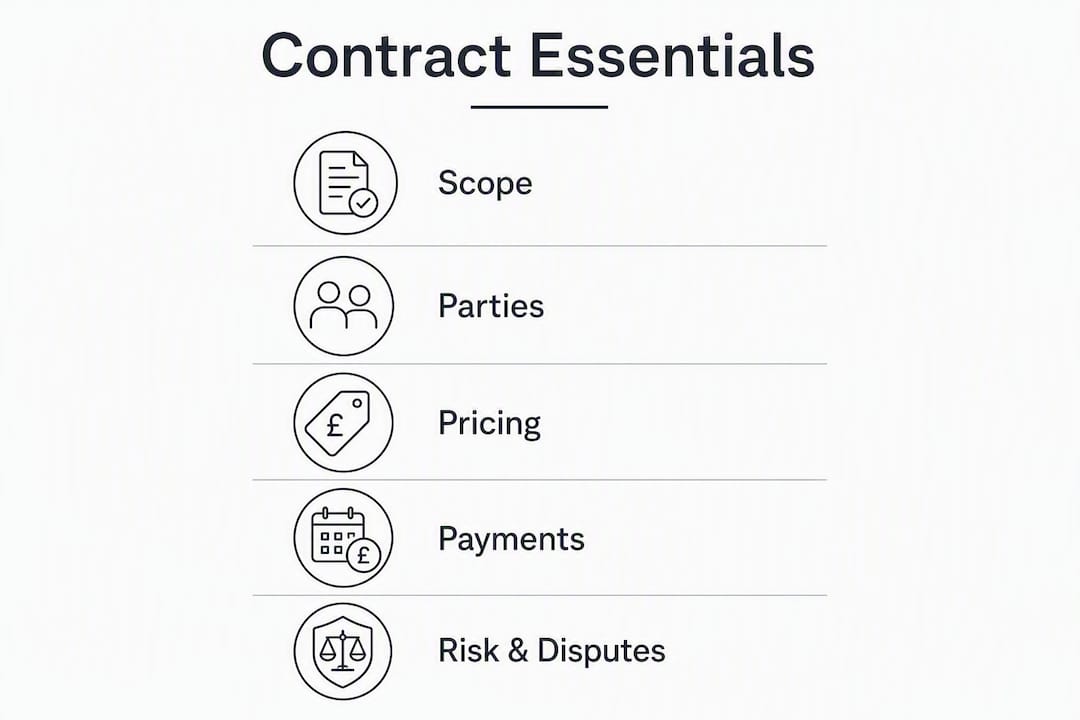
A well-drafted commercial building contract does four things at once:
- Allocates risk between client and contractor (who bears cost overruns, delays, unforeseen ground conditions)
- Governs payment by setting out interim payment cycles, notice obligations and the final account process
- Controls variations by defining how changes to scope are instructed, priced and approved
- Provides a dispute route through adjudication, arbitration or litigation, depending on the form chosen
Table of Contents
- What does UK law say a commercial building contract must cover?
- Who needs a commercial building contract?
- What are the main types of commercial building contract in the UK?
- What clauses should every commercial building contract include?
- How do payment notices and disputes work under the Construction Act?
- How do you manage risk and avoid disputes on a commercial project?
- How can you lawfully end or suspend a commercial building contract?
- When should you instruct a solicitor or specialist adviser?
- Key takeaways
- What we see go wrong — and how to avoid it
- Ajcandsonbuilders: practical support for commercial projects in Liverpool and Merseyside
- Useful sources for further reading
What does UK law say a commercial building contract must cover?
The Construction Act 1996 is the primary statutory framework for construction contracts in England, Wales and Scotland. It imposes mandatory payment provisions (including the right to interim payments and the requirement for payment notices) and grants every party the right to refer a dispute to adjudication at any time. Any contract that purports to exclude these rights is overridden by the Act’s implied terms under the Scheme for Construction Contracts.
The Building Safety Act 2022 adds a further layer for higher-risk buildings, principally residential structures over 18 metres or seven storeys. For commercial projects that fall within its scope, the Act imposes new dutyholder responsibilities on clients, principal designers and principal contractors, with obligations that must be reflected in the contract documents.
A commercial building contract typically catches: the client or employer, the main contractor, and any subcontractors engaged to carry out specialist trades. The scope cues are straightforward: if the work is being carried out for a business purpose, on commercial property, or under a development agreement, a commercial contract form applies. A fit-out of a retail unit, structural alterations to an office building, or the construction of a warehouse all fall squarely within this category. Small domestic works carried out for a homeowner under a residential building contract sit outside this framework, though subcontracts on those same domestic projects can still be caught by the Act.
Who needs a commercial building contract?
The short answer: anyone commissioning or carrying out commercial building work in the UK. In practice, that means:
- Property managers — overseeing refurbishment or maintenance programmes on behalf of asset owners
Timing matters as much as the parties involved. The written contract should be in place before any work starts on site. Starting work without a signed agreement is one of the most common causes of mid-project disputes, because the scope, price and variation process are then open to interpretation by both sides. Statutory obligations under the Construction Act 1996 apply from the moment a construction contract exists, whether written or not, so having the written form agreed in advance simply makes those obligations clear and enforceable.
For shorter or lower-value projects, a concise form is often the right choice rather than a full suite of documents.
Pro Tip: For projects under roughly £150,000 or those with a straightforward, well-defined scope, the RIBA Concise Building Contract or an FMB commercial template offers a proportionate, plain-English framework without the administrative burden of a full JCT or NEC suite. Reserve the fuller forms for complex, multi-phase or high-value schemes.
What are the main types of commercial building contract in the UK?
There is no single correct contract type. The right choice follows the project’s scope definition and risk profile, and aligning contract form to project risk is one of the most consistently cited principles in construction procurement.
Pricing and delivery models
Lump sum (fixed price) contracts suit projects where the scope is fully defined before tender. The contractor carries the risk of cost overruns within the agreed scope, which gives the client cost certainty. This is the most common model for straightforward commercial fit-outs and extensions.

Cost-plus / time and materials (T&M) contracts are appropriate where significant unknowns exist, such as refurbishment of an older building where hidden defects are likely. The client pays actual costs plus an agreed fee or margin, which means the client carries more financial risk but gains transparency.
Guaranteed maximum price (GMP) sits between the two: the contractor commits to a ceiling cost, with any savings shared between the parties. It suits projects where the scope is mostly but not fully defined.
Design and build transfers both design and construction responsibility to the contractor, reducing the client’s coordination burden but requiring careful employer’s requirements documents to protect quality.
Construction management (CM) models, where the client engages a construction manager and multiple trade contractors directly, suit large or complex schemes where the client wants control over procurement.
Standard forms used in the UK
| Contract form | Best suited to | Risk profile |
|---|---|---|
| JCT Standard Building Contract | Mid-to-large commercial projects with a defined design | Balanced; well-understood by UK courts |
| JCT Minor Works | Smaller, straightforward commercial works | Lighter on administration |
| NEC4 Engineering and Construction Contract | Infrastructure, complex or collaborative projects | Collaborative; early-warning focused |
| RIBA Concise Building Contract | Smaller commercial and light-commercial projects | Fair and equitable; plain language |
| FMB commercial templates | SME contractors on light commercial works | Practical; proportionate |
The RIBA Concise Building Contract is notable for its advance-warning mechanics and collaborative problem-solving provisions, which actively encourage parties to flag potential delays before they become disputes. NEC4 takes a similar approach at a larger scale. Both reflect a broader industry shift away from adversarial drafting toward fair, equitable terms that keep projects moving.
What clauses should every commercial building contract include?
A construction contract is an operational guide as much as a legal document. A well-drafted agreement should be used day-to-day to keep the project on track, not filed away until something goes wrong. The following clauses are non-negotiable in any commercial building agreement:
- Scope of works: a precise description of what is and is not included, ideally referencing drawings and specifications by revision number
- Contract sum and pricing basis: whether lump sum, cost-plus or GMP, and how the sum is adjusted
- Payment terms and notices: interim payment schedule, due dates, payment notice obligations under the Construction Act 1996, and the pay-less notice procedure
- Programme and milestones: start date, completion date, key milestone dates and the consequences of delay
- Variations / change orders: how changes are instructed in writing, how they are priced and who approves them before work proceeds
- Notice procedures: the form, timing and recipient of contractual notices (defects, delays, claims)
- Defects and rectification: the defects liability period, the contractor’s obligation to return and remedy, and the client’s right to engage others if the contractor fails to do so
- Insurance and indemnities: minimum levels of public liability, employer’s liability, professional indemnity (where design is involved) and contract works insurance
- Health and safety: CDM 2015 dutyholder roles, site rules and compliance obligations
- Retention and holdback: the percentage withheld, the release mechanism and the conditions for release of the second half
- Warranties and collateral warranties: third-party rights for funders, tenants or purchasers
Pro Tip: Failing to define the variation approval and pricing process precisely is the single most common cause of mid-project payment disputes. Every variation should be instructed in writing, priced before work proceeds where possible, and logged with a unique reference number. Keep a running variation register from day one.
How do payment notices and disputes work under the Construction Act?
The Construction Act 1996 gives every party to a construction contract the right to interim payments and imposes a statutory timetable for payment notices. The paying party must issue a payment notice by a specified date; if they intend to pay less than the notified sum, they must serve a pay-less notice within a defined period before the final date for payment. Failure to serve a valid pay-less notice means the full notified sum becomes due, regardless of any dispute about its merits.

When a payment or performance dispute arises, adjudication is the statutory fast-track route. Either party can refer a dispute to an adjudicator at any time, and the adjudicator must reach a decision within 28 days (extendable to 42 days with the referring party’s consent). The decision is temporarily binding and enforceable through the courts while the project continues, which means cash flow is protected even while a longer dispute is resolved. Arbitration or litigation then provides the final, permanent resolution if either party wishes to challenge the adjudicator’s decision.
The typical payment-dispute sequence runs: contractor submits application → client issues (or fails to issue) payment notice → pay-less notice deadline passes → payment falls due → if unpaid, contractor refers to adjudication → adjudicator’s decision → enforcement in court if necessary.
Common dispute triggers include unagreed variations that were carried out without a written instruction, late or defective payment notices, and programme delays where the cause is contested between the parties.
How do you manage risk and avoid disputes on a commercial project?
Practical risk management starts before you sign. Red flags in a draft contract worth challenging include: scope descriptions that reference only general intentions rather than specific drawings; variation clauses that allow the employer to instruct unlimited changes without a pricing mechanism; unilateral termination rights that give one party the power to end the contract without cause; and insurance schedules that specify minimum sums without requiring evidence of cover.
A structured contract-management approach through the project lifecycle reduces the chance of disputes reaching adjudication:
- Pre-contract: obtain a complete set of drawings and specifications; confirm all approvals and building regulations are in place or programmed; agree the variation process in writing before signing
- Mobilisation: hold a contract kick-off meeting; confirm the programme, site rules, CDM dutyholder appointments and insurance certificates
- During works: issue all instructions in writing; log every variation with a reference number, description and agreed or estimated cost; record site progress with dated photographs
- Interim payments: submit applications on time; respond to payment notices within the contractual period; flag any pay-less notice immediately
- Practical completion: agree the snagging list in writing; confirm the defects liability period start date; release the first half of retention
- Defects period: respond promptly to defect notifications; agree the final account before the defects liability period expires; obtain release of the second half of retention
Pro Tip: Keep a single, timestamped correspondence log throughout the project. Every email, letter and notice should be filed by date and contract reference. If a dispute arises, this log is your most valuable asset — it establishes the sequence of events and demonstrates that notices were served correctly.
Questions to ask the other party at contract handover: Is the scope fully defined in the attached documents? Who is authorised to instruct variations? What is the insurance excess, and who bears it? What are the liquidated damages provisions, and are they a genuine pre-estimate of loss?
How can you lawfully end or suspend a commercial building contract?
Termination is a serious step, and getting it wrong can expose the terminating party to a damages claim. The most common lawful grounds are: material breach (for example, persistent non-payment or persistent failure to proceed regularly and diligently); insolvency of either party; and prolonged suspension of the works beyond a defined period, often 60 days or more under standard forms.
Most standard forms require the innocent party to serve a written notice specifying the breach and giving the defaulting party a cure period, typically 14 days, before termination can be effected. Suspension rights under the Construction Act 1996 allow a contractor to suspend performance for non-payment after giving seven days’ written notice, without that suspension constituting a breach.
When facing potential termination, the immediate steps are: serve the required notice in the correct form and to the correct address; preserve all site records, photographs and correspondence; secure any materials or plant on site to which you have title; and take legal advice before taking any further action. Common remedies include damages for breach, recovery of the value of work done on a quantum meruit basis, and, in some cases, specific performance or injunctive relief.
When should you instruct a solicitor or specialist adviser?
Not every contract question requires a solicitor, but certain situations make legal advice a sound investment rather than an optional extra. Practical triggers include: a contract sum above £50,000; unclear liability for design or structural elements; a high-value variation that the other party disputes; a threatened termination notice; any situation involving the Building Safety Act 2022 dutyholder obligations; or a dispute that has reached the point of formal correspondence.
For cost guidance, a fixed-fee contract review by a construction solicitor typically runs from a few hundred pounds for a short-form agreement to several thousand for a full JCT suite with bespoke amendments. Adjudication, while faster and cheaper than litigation, still involves adjudicator fees and legal costs that can reach tens of thousands of pounds on a contested dispute. These figures are indicative and should be confirmed with your adviser based on the specific contract and dispute.
Documents to provide a solicitor for an efficient review:
- The full contract draft, including all schedules and appendices
- Any pre-contract correspondence that forms part of the agreement
- The programme and milestone schedule
- Payment records and any notices already served
- Drawings and specifications referenced in the scope
This article provides general information about commercial building contracts in the UK and is not legal advice. For matters affecting your specific rights and obligations, consult a qualified construction solicitor or specialist adviser.
Key takeaways
A commercial building contract is a legally binding written agreement that allocates risk, governs payment, and controls variations — and getting it right before works start is the single most effective way to protect both parties throughout a project.
| Point | Details |
|---|---|
| Get it in writing | A signed contract before works start is legally required in many commercial contexts and protects both parties under the Construction Act 1996. |
| Check payment and variation clauses | Undefined variation processes and missed payment notices are the leading causes of mid-project disputes on commercial projects. |
| Match the form to the risk | Use lump sum and JCT for defined scopes; NEC or cost-plus where significant unknowns exist; RIBA Concise or FMB templates for smaller works. |
| Keep contemporaneous records | A timestamped correspondence log, variation register and site photographs are your strongest evidence if a dispute arises. |
| Ajcandsonbuilders | Ajcandsonbuilders supports clients across Liverpool and Merseyside with practical contract preparation, project delivery and light commercial structural works. |
What we see go wrong — and how to avoid it
The contracts that end in adjudication almost always share one characteristic: the scope was never properly fixed before work started. One party assumed the price covered something; the other assumed it did not. By the time the disagreement surfaces, both sides have invested time, money and goodwill, and the dispute is harder to resolve than it would have been at the outset.
The second most common failure is the variation that was agreed verbally on site and never confirmed in writing. Both parties remember the conversation differently six months later. A brief email confirming the instruction, the agreed scope and the indicative cost takes two minutes to send and can prevent weeks of argument.
From our experience on commercial and light-commercial projects across Merseyside, the clients who have the smoothest projects are those who treat the contract as a working document: they refer to the programme at every site meeting, they issue written instructions for every change, and they respond to payment notices on time. The contract does not prevent problems, but it gives both parties a clear, agreed framework for resolving them quickly.
If you are approaching a commercial project and want a practical review of your contract position or a clear scope of works before you commit, we would encourage you to get in touch with the Ajcandsonbuilders team.
Ajcandsonbuilders: practical support for commercial projects in Liverpool and Merseyside
For clients and contractors in Liverpool and Merseyside who need more than a template contract, Ajcandsonbuilders brings hands-on experience across commercial fit-outs, light commercial structural works, extensions and full renovation projects. Where other routes leave you managing paperwork alone, we work alongside you from scope definition through to practical completion, helping you identify contract risks before they become site problems.

Our building services in Liverpool and Merseyside cover the full range of light commercial and residential works, from structural steelwork and brickwork to full fit-outs and extensions. We understand the contractual obligations that come with commercial projects, including CDM 2015 duties, payment notice requirements and the practical record-keeping that protects your position.
Whether you are a landlord commissioning a tenant fit-out, a developer managing a mixed-use scheme, or a business owner extending your premises, contact Ajcandsonbuilders for a free, no-obligation quote and a straightforward conversation about your project scope and contract requirements.
Useful sources for further reading
The following authoritative sources provide the primary material underpinning this guide. We recommend consulting them directly for the statutory text and standard-form documentation relevant to your project.
- Housing Grants, Construction and Regeneration Act 1996 (Construction Act): the primary UK statute governing payment rights and adjudication in construction contracts. Read this for the statutory payment notice requirements and adjudication framework.
- Scheme for Construction Contracts (England and Wales) Regulations 1998: the implied terms that apply when a construction contract fails to comply with the Act’s payment provisions. Particularly relevant if your contract is silent on payment notice timescales.
- RIBA Concise Building Contract: the RIBA’s plain-language standard form for smaller commercial and light-commercial projects, with built-in advance-warning and collaborative dispute-avoidance mechanics. Published by the Royal Institute of British Architects.
- JCT (Joint Contracts Tribunal): the most widely used suite of standard forms for UK commercial construction, ranging from Minor Works to the full Standard Building Contract. Available at jctltd.co.uk.
- NEC (New Engineering Contract): the NEC4 suite is widely used on infrastructure and complex commercial projects, with a strong emphasis on collaborative management and early-warning obligations. Available at neccontract.com.
- FMB (Federation of Master Builders): the FMB publishes commercial contract templates suited to SME contractors and smaller commercial works. Available at fmb.org.uk.
- Ajcandsonbuilders blog and practical guides: local, implementation-focused guidance for owners and contractors working on projects in Liverpool and Merseyside, covering topics from building regulations approval to renovation project stages.