

For every routine contractor visit to your rental property, you must give at least 24 hours’ written notice under Section 11(6) of the Landlord and Tenant Act 1985, never force entry except in a genuine emergency, and keep a documented audit trail of every visit. That is the legal baseline. The operational minimum sits on top of it.
Three steps to act on immediately:
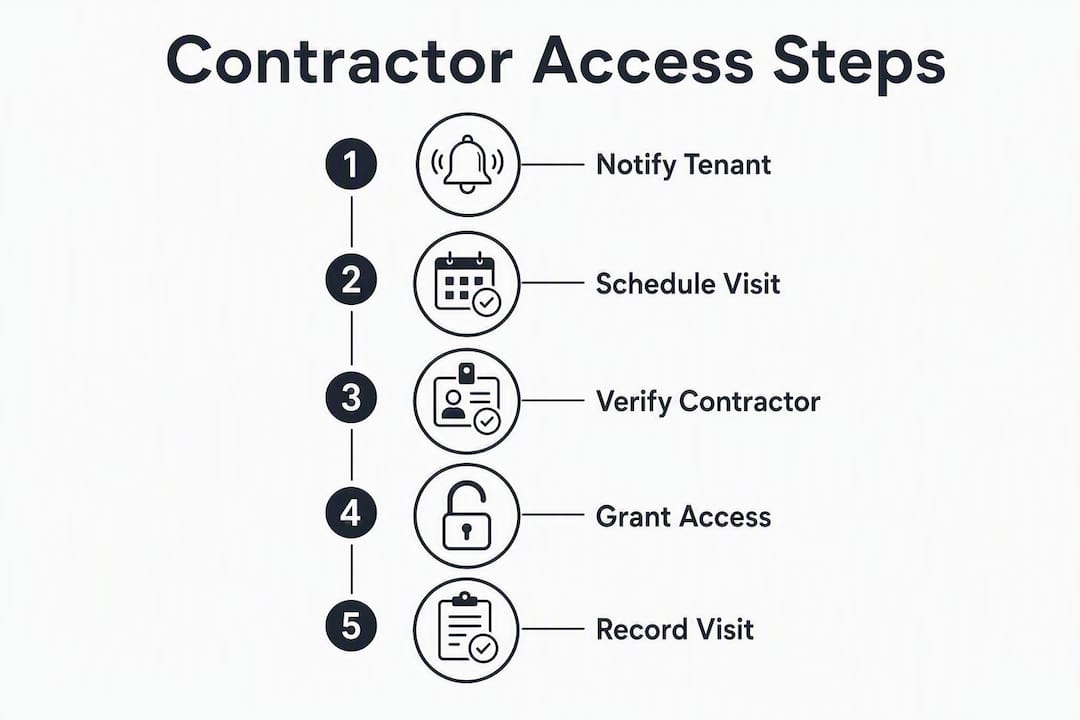
- Serve written notice at least 24 hours before any visit, stating the reason, date, time window, and who will attend.
- Verify contractor documents before granting access: a Certificate of Insurance (COI) naming you as Additional Insured, plus Gas Safe registration for gas work or NICEIC/NAPIT certification for electrical work.
- Record every visit in a log: arrival and departure times, works completed, and any photographic evidence.
Ajcandsonbuilders, operating across Liverpool and Merseyside, follows this exact workflow on every rental property job, producing COIs, completion certificates, and visit logs as standard. The sections below explain each step in full, with templates you can use straight away.
Pro Tip: Write your access protocol into the tenancy agreement from day one. With written tenancy agreements now required under updated UK legislation, there is no better moment to set clear expectations in the paperwork before any contractor ever sets foot on the property.

Table of Contents
- What are the legal rules for managing contractor access to rental properties?
- When can you enter a rental property without giving notice?
- How do you vet contractors before granting access to a rental property?
- How should you schedule contractor visits and communicate with tenants?
- What are the safest options for giving contractors access to your property?
- What records should you keep after every contractor visit?
- How do access rules differ for HMOs?
- What should you do when a tenant refuses access?
- Ready-to-use templates for landlords
- How Ajcandsonbuilders manages contractor access on a rental property job
- Key takeaways
- Why documentation matters more than legal powers
- Ajcandsonbuilders: vetted local contractors for Liverpool and Merseyside landlords
- Useful sources for landlords
What are the legal rules for managing contractor access to rental properties?
Section 11(6) of the Landlord and Tenant Act 1985 gives landlords the right to enter a property at reasonable times to carry out repairs and inspections, provided they give at least 24 hours’ written notice. That 24-hour window is the statutory minimum, not a target to aim for. NRLA guidance is clear that best practice goes further: securing the tenant’s written permission, rather than relying solely on the notice power, produces far fewer disputes and legal challenges.
The notice requirement applies to all routine visits: maintenance inspections, gas safety checks, Electrical Installation Condition Reports (EICRs), and contractor-led repairs. It does not apply to genuine emergencies, which are covered separately below.
What counts as a ‘reasonable time’?
Courts and the Housing Ombudsman treat daytime weekday hours (roughly 8 AM to 6 PM) as the default reasonable window, though this is not defined in statute. For shift workers or tenants with care responsibilities, you should offer flexibility. Housing Ombudsman practice and social-landlord norms treat 48 hours as the operating standard, even though the law requires only 24. Offering 48 hours where practicable reduces refusals and demonstrates good faith.
Notice delivery and content:
- State the reason for the visit (e.g., annual gas safety inspection, repair to roof flashing).
- Confirm the date and a specific time window (e.g., 10 AM to 12 PM).
- Name the contractor or trade who will attend.
- Deliver by email or text, keeping a sent-message record as your audit trail. A verbal call does not satisfy Section 11(6) evidential requirements.
Different visit types carry slightly different considerations. A statutory gas safety check under the Gas Safety (Installation and Use) Regulations 1998 is a legal obligation; a marketing viewing is not, and tenants can reasonably decline it. Where your tenancy agreement includes an access clause, that clause supplements the statutory right but cannot reduce it below the 24-hour minimum. With written tenancy agreements now required under updated UK legislation, including a clear access clause in your standard terms is straightforward and worth doing from the outset. The GOV.UK model tenancy agreement provides a useful starting point for drafting those terms.
When can you enter a rental property without giving notice?
Emergency access is the only lawful exception to the 24-hour written notice rule. Genuine emergencies include a major water leak threatening structural damage, a fire, a suspected dangerous gas leak, or any immediate risk to life or property. The test is honest, reasonable belief: you or your contractor must genuinely believe that waiting 24 hours would cause serious harm.
What does not qualify: a boiler that stopped working overnight, a dripping tap, or a repair you simply want to complete quickly. These are urgent, not emergencies.
Emergency entry documentation checklist:
| Field | What to record |
|---|---|
| Trigger | Specific reason entry was necessary without notice |
| Who entered | Full name and trade of contractor(s) |
| Time in / time out | Exact times, with date |
| Actions taken | Works carried out, materials used |
| Photographic record | Photos of the issue before and after |
| Repairs needed | Any follow-up works required |
| Tenant notification | Written notice sent to tenant within 24 hours of entry |
After any emergency entry, notify the tenant in writing within 24 hours, explaining what happened, who entered, and what was done. If forced entry was necessary, repair any damage to doors or locks at your cost and retain receipts. Contemporaneous records, created at the time rather than reconstructed later, carry far more weight with insurers and courts.
How do you vet contractors before granting access to a rental property?
Negligent-hiring liability can fall on you as the landlord if a contractor causes damage, injury, or a safety breach. The practical defence is a consistent pre-access vetting process applied to every contractor, regardless of how long you have used them.
Minimum documents to obtain before any contractor visits:
- Certificate of Insurance (COI): Public liability cover of at least £1 million (£2 million for larger works), employers’ liability if they have staff, and your name listed as Additional Insured.
- Gas Safe registration: Mandatory for any gas work. Verify the engineer’s registration number directly on the Gas Safe Register website before the visit.
- NICEIC or NAPIT certification: Required for electrical installation and inspection work, including EICRs.
- CSCS card: For site-based construction work, a Construction Skills Certification Scheme card confirms the operative’s trade competence.
- DBS check: Where the property houses vulnerable tenants, a Disclosure and Barring Service check is a reasonable additional requirement.
Practical vetting checklist:
- Confirm identity (photo ID) and right to work in the UK.
- Request two trade references and follow them up.
- Obtain a written scope of works with start and finish dates.
- Verify COI expiry date and check the insurer’s contact details are current.
- Require a signed one-page Tenant Interaction Policy confirming the contractor will not solicit side-work or share tenant contact details.
Pro Tip: Check COI expiry dates on the day of the visit, not just when you first engage the contractor. A policy that lapsed between instruction and arrival leaves you exposed.
For guidance on selecting a builder with the right qualifications and documentation, the process is the same whether you are commissioning a full renovation or a single repair.
Contractual protections to include in your written terms of engagement:
| Requirement | Why it matters |
|---|---|
| Indemnity clause | Contractor bears cost of damage they cause |
| H&S compliance confirmation | Contractor confirms CDM and site-safety compliance |
| Asbestos awareness declaration | Required for older properties |
| Data handling agreement | Limits contractor use of tenant contact details |
| Completion sign-off requirement | No final payment without documented completion |
How should you schedule contractor visits and communicate with tenants?
The most effective way to reduce refusals is to involve the tenant in choosing the time window before you issue the formal notice. A brief message asking for preferred dates costs nothing and produces far less friction than a notice that lands on a day the tenant is working nights.
Suggested scheduling workflow:
- Receive repair report or identify maintenance need.
- Contact tenant to agree a preferred date and time window.
- Issue written 24-hour notice (or 48-hour notice where practicable) confirming the agreed details.
- Send a short reconfirmation message 24 hours before the visit.
- Contractor attends; landlord or contractor sends a completion note to the tenant the same day.
For tenants who work shifts, offer at least two alternative windows. For vulnerable tenants, including those with disabilities, serious illness, or mental health conditions, carry out a brief pre-visit risk assessment: confirm whether they need a support person present, whether PPE is required for their protection, and whether the works will cause significant disruption to their daily routine. This is not a bureaucratic exercise; it is the kind of consideration that prevents complaints and demonstrates the duty of care expected of a responsible landlord.
Securing written permission for non-statutory access:
Where a visit is not required by law (a routine inspection rather than a gas safety check, for example), NRLA guidance recommends confirming tenant permission in writing. A short email or text exchange serves this purpose. Keep the thread.
Health precautions for contractor visits:
- Confirm with the contractor that they will not attend if symptomatic with a contagious illness.
- For vulnerable tenants, request that contractors wear appropriate PPE and ventilate the working area.
- Record any specific health precautions agreed in the visit log.
What are the safest options for giving contractors access to your property?
Physical keys remain the most common method, but they carry the highest risk: an untracked spare key handed to a contractor creates an audit gap that is difficult to close after the fact. Landlords who hold keys cannot use them to enter without proper notice; repeated unauthorised entry can constitute harassment. The same principle applies to contractors acting on your behalf.
| Access method | Audit capability | Tenant disruption | Risk level |
|---|---|---|---|
| Physical key (tracked) | Low | Low | Medium |
| Coded key safe | Medium | Low | Medium |
| Temporary smart-lock code | High | Low | Low |
| Managed keyholding service | High | Low | Low |
| Tenant present to admit | High | Medium | Low |
Modern access control systems support time-bound codes, contractor verification, and centralised audit logs, which substantially reduce human error and access disputes compared with ad-hoc physical keys. A temporary code issued for a specific date and time window, set to expire automatically after the visit, is the most auditable option available to private landlords today.
Practical guidance by method:
- Coded key safe: Change the code after every contractor visit. Never use the same code for multiple contractors.
- Smart-lock temporary codes: Issue a unique code per contractor per visit. Confirm the code has expired after works are complete.
- Managed keyholding service: Useful for HMOs or multi-property portfolios; the service logs every access event and provides a written record.
- Untracked master keys: Avoid entirely. If a master key must be issued, log the issue date, return date, and contractor name, and change the lock if the key is not returned.
Pro Tip: Rotate smart-lock codes immediately after works finish. A code that remains active beyond the agreed visit window is a security liability, regardless of how trustworthy the contractor is.
Data privacy: Share tenant contact details with contractors only on a need-to-know basis. Log when you shared the information, with whom, and for what purpose. This is a straightforward UK GDPR obligation and one that is easy to satisfy with a brief note in your contractor file.
What records should you keep after every contractor visit?
Good recordkeeping is the single most effective way to reduce your exposure to negligent-hiring claims, insurance disputes, and tenant complaints. A coherent audit trail demonstrates that you acted reasonably at every stage.
Records to retain by document type:
| Document | Retention period | Why it matters |
|---|---|---|
| Written access notices | Duration of tenancy + 6 years | Evidence of lawful entry |
| Tenant replies / consent | Duration of tenancy + 6 years | Confirms agreement or refusal |
| COIs | 6 years after works completed | Negligent-hiring defence |
| Gas Safety Certificate (CP12) | 2 years minimum (keep all) | Legal requirement; HSE inspection |
| EICR | Until next EICR (typically 5 years) | Electrical safety compliance |
| Visit logs | Duration of tenancy + 6 years | Audit trail for disputes |
| Invoices and completion sign-offs | 6 years | Tax records and dispute evidence |
| Photographic condition records | Duration of tenancy + 6 years | Deposit and damage disputes |
Visit log template fields:
- Date and time of arrival and departure
- Contractor name, company, and trade
- Document checks completed (COI verified, Gas Safe/NICEIC confirmed)
- Works carried out (brief description)
- Any issues found and follow-up required
- Contractor signature (or digital confirmation)
- Landlord or agent countersignature
Store records electronically in a named folder per property, with sub-folders by year. Cloud storage with version history (Google Drive, Microsoft OneDrive, or Dropbox) provides both backup and a timestamped record. Send the tenant a brief completion note after each visit; this closes the communication loop and reduces the likelihood of a later dispute about what was done.
For properties with ongoing maintenance programmes, understanding common brickwork issues and other structural concerns helps you anticipate the frequency of contractor visits and plan your recordkeeping accordingly.
How do access rules differ for HMOs?
HMOs introduce a distinction that catches many landlords out. Communal areas such as hallways, kitchens, bathrooms, and stairwells are generally accessible to the landlord under HMO management duties, because no individual tenant holds exclusive possession of those spaces. Private rooms are a different matter entirely.
A tenant’s private, exclusive-use room carries the same notice and consent protections as any other tenancy. Entering without the required 24-hour written notice, except in a genuine emergency, risks harassment claims and potential unlawful-entry liability. The fact that you hold a master key to the building does not change this.
HMO-specific access considerations:
- Check your HMO licence conditions: many local authorities include specific access and inspection requirements, and non-compliance can attract civil penalties.
- Draft house rules that set clear expectations for contractor visits to communal areas, including notice periods and typical visit windows.
- Where a tenant rents a room only (rather than a whole unit), the tenancy agreement should specify which areas are communal and which are private.
- For fire safety inspections and gas safety checks in communal areas, document each visit in the same way as a private-room visit.
HMO licensing requirements vary by local authority. Liverpool City Council, for example, publishes its own HMO licensing conditions, which landlords in Merseyside should review alongside national guidance. Non-compliance with licence conditions is treated seriously; civil penalties can be substantial.
What should you do when a tenant refuses access?
A refusal is not the end of the road, but it does require a measured, documented response. The worst thing you can do is attempt entry anyway or send repeated visits intended to pressure the tenant into compliance.
Step-by-step escalation:
- Document the refusal in writing immediately, noting the date, time, and method of communication.
- Offer at least two alternative dates and time windows in writing, and keep the tenant’s response on file.
- If the refusal relates to a statutory safety check (gas inspection, EICR), explain in writing that the check is a legal requirement and that you are obliged to carry it out.
- After three documented, reasonable attempts, you have the evidential foundation to seek a court injunction if necessary. Guidance confirms that demonstrating all reasonable steps were taken protects both your legal position and your insurer’s position.
- Consider mediation before court action. Many disputes resolve quickly once a neutral third party is involved.
Actions to avoid:
- Changing the locks or restricting the tenant’s access to the property.
- Entering without notice on the basis that the tenant “probably won’t mind.”
- Sending the contractor to the property unannounced in the hope the tenant will simply admit them.
- Making repeated contact in a short period, which can constitute harassment.
If the matter proceeds to court or tribunal, your file of written notices, tenant responses, and documented alternative offers is your evidence. Without it, the case becomes your word against the tenant’s.
Ready-to-use templates for landlords
24-hour written access notice
Subject: Notice of contractor visit — [Property address]
Dear [Tenant name],
We are writing to give you at least 24 hours’ notice that a contractor will be attending the above property on [date] between [time] and [time].
Reason for visit: [e.g., Annual gas safety inspection / repair to roof flashing]
Contractor attending: [Name / company / trade]
Please let us know if this time is inconvenient and we will arrange an alternative. If we do not hear from you, we will proceed as planned.
[Landlord name, contact details, date]
Contractor vetting checklist
Before granting access, confirm the following:
- Photo ID verified and right to work confirmed.
- COI received, naming you as Additional Insured; expiry date checked.
- Gas Safe registration number verified (gas work only).
- NICEIC or NAPIT certification confirmed (electrical work only).
- CSCS card sighted (construction/site work).
- DBS check obtained where vulnerable tenants are present.
- Written scope of works agreed, with start and finish dates.
- Tenant Interaction Policy signed by contractor.
- Two trade references followed up.
Contractor visit log
Complete this log for every visit:
- Property address and date of visit.
- Contractor name, company, and trade.
- Documents verified on the day (COI, Gas Safe/NICEIC, ID).
- Time of arrival and time of departure.
- Works carried out (brief description).
- Issues found and any follow-up required.
- Photographic record taken (yes/no; file reference).
- Contractor signature (or digital confirmation).
- Completion note sent to tenant (yes/no; date sent).
Store completed logs in a named electronic folder per property. Send the tenant a copy of the completion note the same day.
How Ajcandsonbuilders manages contractor access on a rental property job
The workflow Ajcandsonbuilders uses on rental property jobs in Liverpool and Merseyside illustrates how the guidance above translates into practice.
Step-by-step workflow from instruction to completion:
- Initial enquiry: Landlord contacts Ajcandsonbuilders with a repair or works requirement. Scope, timeline, and access constraints are discussed at this stage.
- Vetting documentation provided: Ajcandsonbuilders supplies a COI naming the landlord as Additional Insured, relevant trade certifications (Gas Safe, NICEIC where applicable), and a written scope of works before any visit is confirmed.
- Scheduling with the tenant: The landlord issues a 24-hour written notice (or 48-hour where agreed) using the agreed time window. Ajcandsonbuilders confirms attendance in writing.
- Access method agreed: Where the property uses a smart-lock or key safe, a temporary code is issued for the specific visit window. The code is rotated immediately after works are complete.
- Arrival log completed: On arrival, the contractor records time in, works to be carried out, and any pre-existing conditions noted. Photographs are taken before works begin.
- Completion certificate and invoice: On completion, a signed completion certificate is produced, photographs of finished works are filed, and the invoice is issued. The landlord receives all documents within 24 hours.
- Tenant notification: The landlord sends the tenant a brief completion note confirming what was done and any follow-up required.
Working with a local, vetted contractor who provides documentation as standard removes the administrative burden from the landlord and creates a clean audit trail from instruction to completion. For rental properties in Liverpool and Merseyside, that local presence also means faster response times and a contractor who understands the specific property types and building regulations in the area.
For larger projects, including house renovations and extensions, the same workflow scales up with staged access scheduling and phased completion records.
Key takeaways
Managing contractor access to rental properties lawfully requires written 24-hour notice for every routine visit, verified contractor documents before access is granted, and a clear visit log retained for the duration of the tenancy plus six years.
| Point | Details |
|---|---|
| 24-hour written notice | Statutory minimum under Section 11(6) LTA 1985; Longer notice periods such as 48 hours are considered best practice by some landlords and housing bodies, though the statutory minimum remains 24 hours. |
| Verify COI and qualifications | Require a COI naming you as Additional Insured and confirm Gas Safe or NICEIC certification before every visit. |
| Auditable access controls | Use time-bound smart-lock codes or a managed keyholding service; avoid untracked master keys. |
| Retain records for 6 years | Keep notices, visit logs, COIs, certificates, invoices, and photos for the tenancy duration plus six years. |
| Ajcandsonbuilders workflow | Ajcandsonbuilders provides COIs, completion certificates, and visit logs as standard on every rental property job in Liverpool and Merseyside. |
Why documentation matters more than legal powers
The conventional wisdom in landlord circles is that knowing your legal rights is the main protection against disputes. In practice, the opposite is closer to the truth. A landlord who knows Section 11(6) inside out but keeps no written records is far more exposed than one who follows a simple paper trail without knowing the statute number.
What actually protects you is not the right to enter; it is the evidence that you exercised that right correctly. A written notice, a COI on file, a timestamped visit log, and a completion note sent to the tenant the same day: these are the documents that close down disputes before they escalate. They are also what your insurer will ask for first if a claim arises.
There is a second point that tends to get overlooked. Tenants who feel respected and informed are far less likely to refuse access or raise complaints. A brief message asking for a preferred time window costs nothing and produces a cooperative relationship that makes every subsequent visit easier. Relying on legal powers alone, without the courtesy of genuine communication, tends to produce exactly the friction it was meant to avoid.
The landlords who manage contractor access most effectively are not the ones with the most detailed knowledge of housing law. They are the ones with a consistent process, a clear paper trail, and a habit of treating tenants as partners in maintaining the property rather than obstacles to be managed.
Ajcandsonbuilders: vetted local contractors for Liverpool and Merseyside landlords
Landlords managing rental properties in Liverpool and Merseyside need contractors who arrive with their paperwork in order, not just their tools. Ajcandsonbuilders provides COIs, trade certifications, written scopes of works, and completion documentation as standard on every job, which means you spend less time chasing compliance documents and more time managing your portfolio.

Whether you need a straightforward repair, a full house renovation, or a larger extension or loft conversion, Ajcandsonbuilders brings the same documented, landlord-friendly workflow to every project. Local knowledge of Liverpool and Merseyside property types, building regulations, and council requirements means fewer surprises and faster turnaround.
Why landlords in Merseyside choose Ajcandsonbuilders:
- COIs and completion certificates provided on every job, naming the landlord as Additional Insured.
- Written scopes of works and visit logs supplied as standard, supporting your audit trail.
- Local Liverpool and Merseyside presence for responsive scheduling and faster access coordination.
Request a free quote via ajcandsonbuilders.com/services and put a vetted, documented contractor on your next job.
Useful sources for landlords
The guidance in this article draws on the following authoritative sources. Review them directly to verify current rules, as legislation and case law evolve.
- NRLA: Accessing the property during a tenancy — The National Residential Landlords Association’s practical guidance on notice requirements, tenant consent, and best practice for access. The most relevant industry body source for private landlords in England and Wales.
- Shelter England: Repairs and inspections, access to your rented home — Covers tenant rights during inspections and repairs, including HMO private-room protections. Useful for understanding the tenant’s perspective and the limits of landlord access rights.
- GOV.UK: Model agreement for a shorthold assured tenancy — The government’s model tenancy agreement, which includes access clauses and provides a lawful starting point for drafting your own terms.
- Warwick District Council: Access by the landlord and contractors — Local authority guidance that illustrates how the statutory access rules are applied in practice, including the 24-hour notice requirement and the emergency exception.
Keep these links under regular review. Housing legislation, HMO licensing conditions, and Ombudsman guidance are updated periodically, and the rules that apply today may be refined before your next tenancy renewal.
This article provides general information for UK private landlords and does not constitute legal advice. Confirm current rules with GOV.UK, the NRLA, or a qualified solicitor before acting on any specific situation.