Electrics renewal during renovation is the process of replacing or upgrading your home’s wiring, consumer unit, and circuits to meet current safety standards and support modern appliances. Known formally as an electrical installation upgrade, this work sits at the heart of any serious renovation project. Get it right and you gain a safer, more capable home that is ready for EV chargers, heat pumps, and smart technology. Get it wrong and you face surface-mounted trunking, failed inspections, and remedial costs that dwarf the original budget. The key is understanding the process before your walls close.
What does electrics renewal during renovation encompass?
Electrical installation upgrades cover far more than swapping a few sockets. The scope depends on the age and condition of your existing system, but most renovation projects involve at least some of the following:
- Full rewiring replaces every cable in the property. This is necessary when wiring is more than 25–30 years old, uses outdated rubber or aluminium conductors, or fails an Electrical Installation Condition Report (EICR).
- Partial rewiring targets specific circuits, such as a new kitchen or extension, where existing wiring is sound but new loads require dedicated runs.
- Consumer unit replacement upgrades your electrical panel to a modern unit with RCD (residual current device) protection on every circuit. Older fuse boards simply cannot support today’s demand.
- Additional circuits for high-demand appliances: induction hobs, EV chargers, heat pumps, and underfloor heating all require dedicated circuits sized to their load.
- Modern protection devices including AFCIs (arc-fault circuit interrupters) and GFCIs (ground-fault circuit interrupters) are now standard under current safety codes. Panel upgrades trigger compliance upgrades such as AFCI and GFCI protection, extending the scope beyond a simple hardware swap.
- Utility coordination may be required if you are increasing your service capacity, for example moving from a 60-amp to a 200-amp supply.
Permits and certifications are not optional. In England and Wales, electrical work in dwellings falls under Part P of the Building Regulations. A registered electrician can self-certify their work, removing the need for a separate building control application and speeding up your project considerably.
Pro Tip: Ask your electrician to confirm their Part P registration before work begins. Self-certification rights belong to the individual, not the company, so always verify the specific person doing the work.
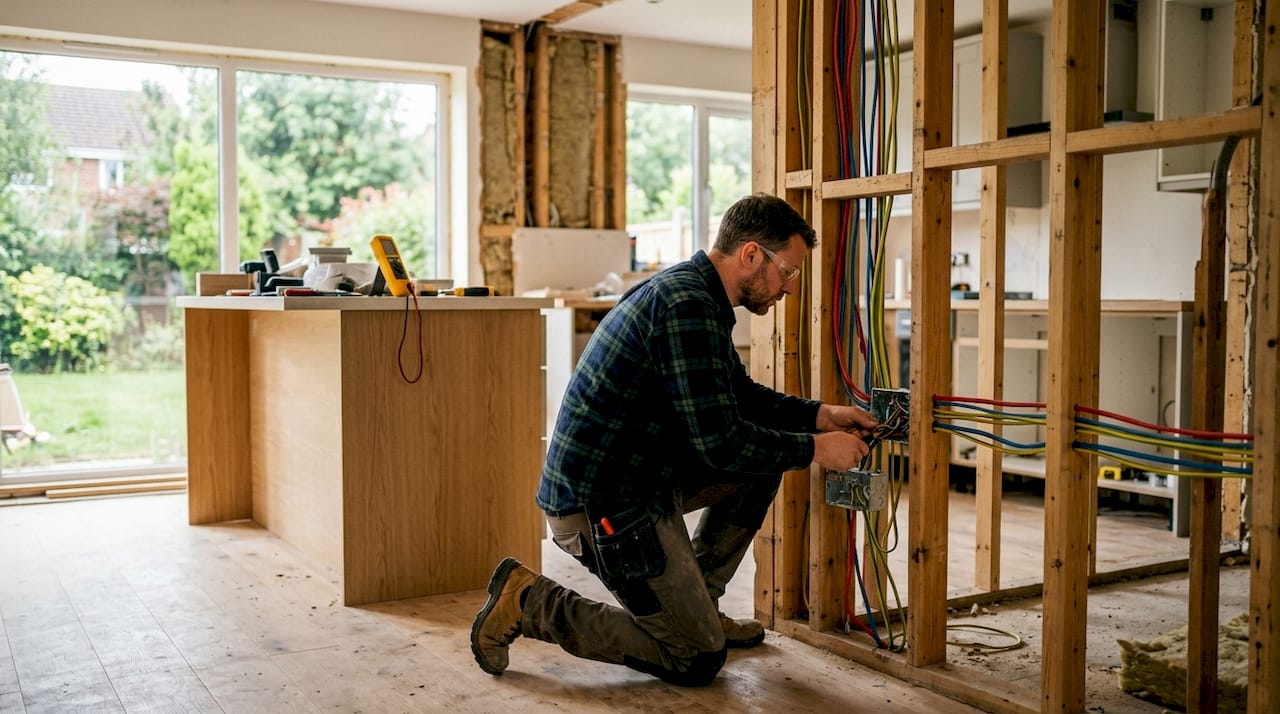
Electrical renewals must be sequenced with other trades. Cables need to run before plasterboard goes up and before plastering begins. Miss that window and you are looking at chasing channels into finished walls or accepting surface-mounted conduit.
When should electrical work be planned and timed during renovation?
Timing is the single biggest variable in whether your electrical upgrade runs smoothly or becomes a source of costly delays. Early electrician involvement in the design stage reduces electrical project costs by 20–30%. That figure reflects a simple truth: decisions made on paper cost nothing to change, while decisions made after plastering can cost thousands.
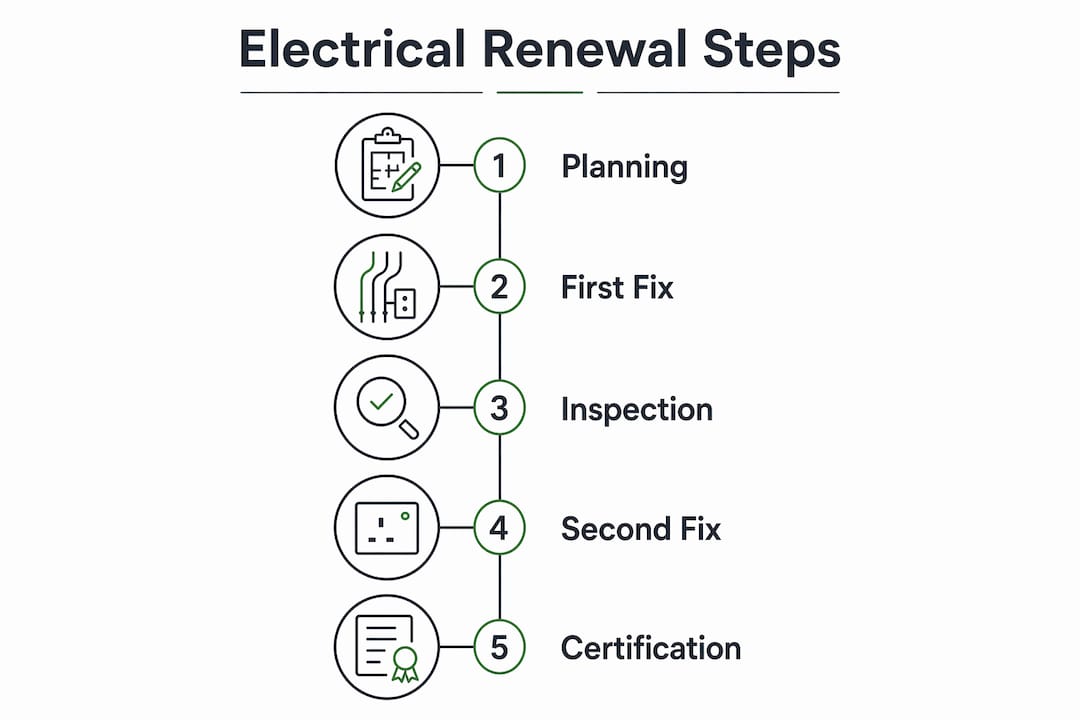
The standard sequence for electrical work in a renovation follows three phases:
- Design and specification — Your electrician reviews the plans, calculates load requirements, and identifies where new circuits, sockets, and lighting points are needed. This happens before any structural work begins.
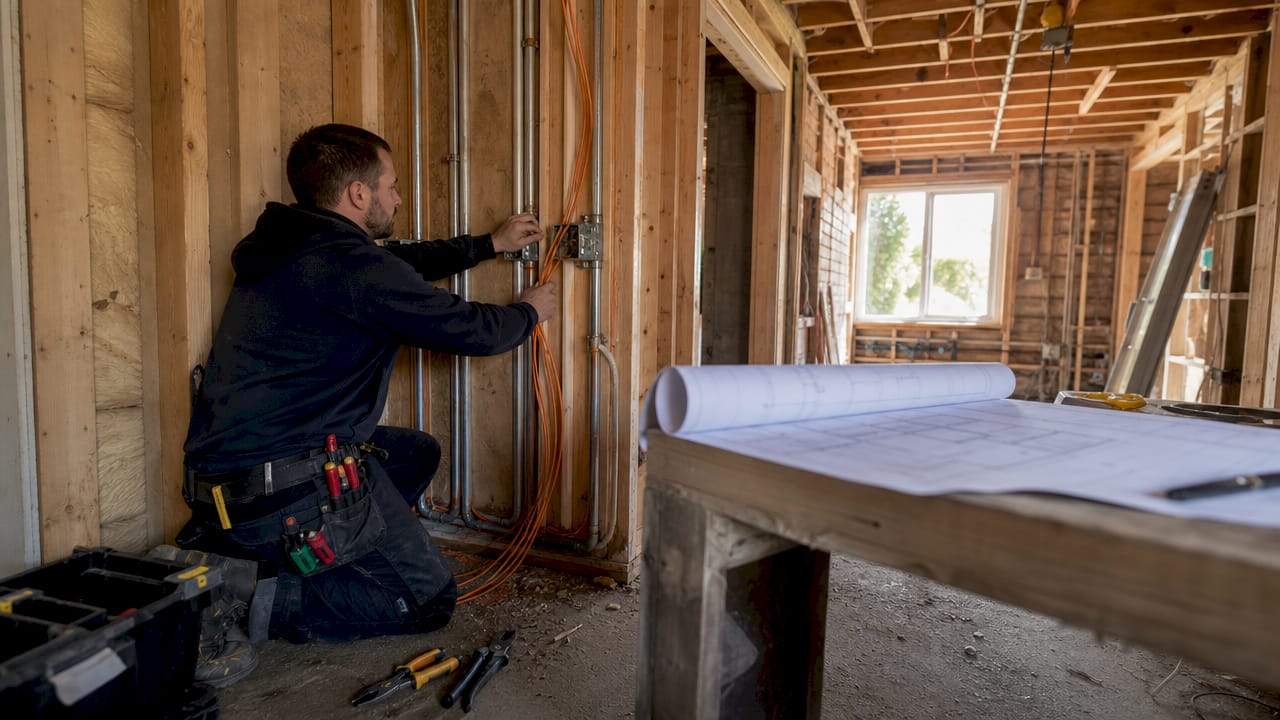
- First-fix wiring — Cables are run through wall cavities, floor joists, and ceiling voids before surfaces are closed. This is the most critical phase. Fishing wire through finished walls increases labour time by 300% compared to first-fix installation. Scheduling this correctly with your builder is non-negotiable.
- Second-fix — Sockets, switches, light fittings, and the consumer unit are connected and tested once decorating is complete. The electrician then issues the completion certificate.
For a typical home of 1,500–2,500 square feet, the full electrical project lifecycle takes 2–4 weeks, with the first-fix phase alone running 3–7 days. Panel installation is usually completed in a single day, but expect a power outage of 4–8 hours during the swap.
Pro Tip: Plan your panel upgrade day in advance. Arrange temporary power for essential equipment, notify anyone working on site, and confirm the utility disconnection window with your network operator at least two weeks ahead.
Electrician timing depends 50% on builder framing readiness. That means your builder and electrician need to communicate directly, not just through you. At Ajcandsonbuilders, we coordinate trades as a matter of course, because delays in framing or structural work cascade directly into electrical scheduling.
What are the key costs and compliance requirements for electrical renewals?
Cost is where many homeowners receive an unpleasant surprise, and usually because they underestimated the scope. A standard residential consumer unit upgrade costs between £1,300 and £4,000, while service capacity upgrades can range from £3,500 to £9,000 depending on complexity. Panel hardware itself is a relatively small part of that figure. Labour and utility coordination represent the majority of the cost.
The table below outlines the main cost categories you should budget for:
| Work type | Typical cost range | Key driver |
|---|---|---|
| Consumer unit replacement | £1,300–£4,000 | Labour and compliance upgrades |
| Full rewiring (3-bed house) | £3,000–£6,000 | Property size and access |
| Service capacity upgrade | £3,500–£9,000 | Utility coordination and civil works |
| Additional circuit installation | £200–£600 per circuit | Cable run length and load rating |
| AFCI/GFCI device upgrades | £50–£150 per device | Triggered by panel or wiring renewal |
Compliance requirements are not negotiable. All electrical work in dwellings must meet the IET Wiring Regulations (BS 7671), currently in their 18th edition. Part P of the Building Regulations requires that notifiable electrical work is either carried out by a registered competent person or inspected by building control.
Key compliance points to understand:
- Load calculations are mandatory when adding high-demand appliances such as induction ranges or heat pumps. These calculations document the legality of the upgrade and are required for inspection sign-off.
- Qualified electricians can self-certify under Part P, removing the need for building control applications and speeding up approvals considerably.
- Permits pulled in the homeowner’s name create personal liability for code compliance. Registered electricians pull permits to protect you from that risk.
Compliance also affects your property’s future value. Buyers’ solicitors routinely request electrical certificates. Missing paperwork can delay or collapse a sale, and insurers may reject claims on properties with uncertified electrical work.
How can you future-proof your electrical system during renovation?
Renovation is the lowest-cost opportunity you will ever have to future-proof your electrical installation. Once walls are closed, adding capacity means opening them again. Installing conduits and additional wiring while walls are open is cost-effective future-proofing that would cost several times more to retrofit later.
Practical steps to build in during your renovation:
- Run spare conduit through wall cavities and floor voids. Empty conduit costs very little during first-fix and allows future cable pulls without opening walls.
- Upsize your consumer unit. A modular unit with spare ways allows you to add circuits for an EV charger or heat pump without replacing the board again.
- Plan for EV charging. A dedicated 7kW or 22kW circuit requires its own breaker and earthing arrangement. Routing the cable during first-fix takes an hour; retrofitting it through a finished garage costs considerably more.
- Consider three-phase supply if you are installing a heat pump and EV charger simultaneously. Three-phase wiring during renovation is straightforward; upgrading later involves utility applications and civil works.
- Install smart-ready wiring. Structured cabling for smart lighting, security cameras, and home automation is far simpler to run during first-fix than after decoration.
- Document everything. Photograph cable routes before walls close. Keep a copy of the electrical installation certificate, the EICR, and any completion notices. This paperwork is valuable at resale and for future contractors.
Pro Tip: Ask your electrician to label every circuit in the consumer unit clearly and to provide a circuit schedule. A well-documented board saves hours of diagnostic time for any future work.
Thinking ahead during your house renovation is not about spending more now. It is about avoiding far greater expense later, and about ensuring your home is genuinely ready for the technology that is already becoming standard.
Key takeaways
Electrics renewal during renovation requires early planning, correct sequencing with other trades, and full compliance with Part P and BS 7671 to avoid costly remedial work and failed inspections.
| Point | Details |
|---|---|
| Plan before walls close | Involve your electrician at the design stage to cut costs by 20–30% and avoid surface-mounted wiring. |
| First-fix timing is critical | Running cables before plastering is up to 300% cheaper than fishing wire through finished walls. |
| Compliance is non-negotiable | All notifiable work must meet IET Wiring Regulations BS 7671 and Part P of the Building Regulations. |
| Budget for the full scope | Consumer unit upgrades cost £1,300–£4,000; service upgrades can reach £9,000 when utility work is included. |
| Future-proof while walls are open | Run spare conduit and upsize your consumer unit now to avoid expensive retrofits for EV chargers or heat pumps. |
What I have learned from managing electrical renewals on renovation sites
The most common mistake I see is treating the electrician as a finishing trade rather than a design partner. Homeowners book them for the second-fix and then wonder why the first-fix was rushed, the cable routes are awkward, and the consumer unit ended up in the wrong location. Electrical planning belongs at the table before a single wall comes down.
Budgeting is the second area where expectations consistently fall short. The hardware is rarely the expensive part. Labour, utility coordination, and the compliance upgrades triggered by a panel swap are where costs accumulate. My advice is to add 20% to any electrical quote as a contingency for scope changes, because renovation sites always reveal surprises once walls open.
Selecting a qualified electrician matters more than price. Verify their Part P registration, ask for references from recent renovation projects, and confirm they will handle the certification paperwork. An uncertified installation is a liability that follows the property, not just the current owner.
Finally, the future-proofing conversation is one worth having even if you have no immediate plans for an EV or heat pump. The cost of running a spare conduit during first-fix is negligible. The cost of not doing so, when you need it in three years, is not.
— Will
Planning a renovation in Liverpool or Merseyside?
Ajcandsonbuilders works with homeowners and property developers across Liverpool and Merseyside, managing renovation projects from structural works through to trade coordination and compliance. We understand that electrical renewal sits at the heart of a successful renovation, and we plan every project so that your electrician and builder work in sequence, not in conflict.

Our house renovation services cover full project management, including scheduling electrical first-fix at the right stage, coordinating with certified electricians, and ensuring all compliance paperwork is in order before handover. If you are planning a renovation and want to get the electrical side right from the start, contact Ajcandsonbuilders for a free consultation. You can also view our building services to see the full range of work we manage across Merseyside.
FAQ
What is electrics renewal during renovation?
Electrics renewal during renovation is the process of upgrading or replacing a property’s wiring, consumer unit, and circuits to meet current safety standards and support modern electrical demand. It is formally governed by BS 7671 IET Wiring Regulations and Part P of the Building Regulations in England and Wales.
When should I involve an electrician in my renovation?
Involve your electrician at the design stage, before any structural work begins. Early involvement reduces electrical project costs by 20–30% and prevents the need for expensive remedial work once walls are closed.
Do I need a permit for electrical work during renovation?
Yes. Notifiable electrical work in dwellings requires either self-certification by a Part P registered electrician or inspection by building control. A registered electrician handles this process and protects you from personal liability for compliance.
How long does a full electrical renewal take?
For a home of 1,500–2,500 square feet, the full electrical project typically takes 2–4 weeks. The first-fix phase runs 3–7 days, and consumer unit installation is usually completed in a single day with a 4–8 hour power outage.
Does renewing electrics add value to my property?
Yes. A certified electrical installation with up-to-date wiring, a modern consumer unit, and full compliance documentation is a material asset at resale. Missing certificates can delay or block a sale, and insurers may reject claims on properties with uncertified electrical work.