
If you employ anyone in the UK, you must have employers’ liability insurance, with a minimum of £5 million cover. That is the one statutory requirement written into law. Everything else, including public liability, is not technically compulsory, but in practice you cannot get near a client, a main contractor or a local authority tender without it.
Here is the immediate action: confirm your employers’ liability certificate meets the £5 million minimum, then secure public liability cover before you set foot on any site or sign any contract.
- Employers’ liability: legally required if you employ staff; £5 million minimum.
- Public liability: not a legal requirement, but demanded by almost every client and main contractor, typically at £1 million to £5 million, rising to £10 million on larger jobs.
- Non compliance risk: fines of up to several thousand pounds per day for missing employers’ liability cover.
Pro Tip: Even as a sole trader with no employees, ask for a public liability quote before you quote the job. Clients increasingly want to see it before they will let you through the door.
Key Takeaways
UK builders must hold employers’ liability insurance at a £5 million minimum by law, and should treat public liability, contract works and correct subcontractor classification as practical necessities for winning and completing work.
| Point | Details |
|---|---|
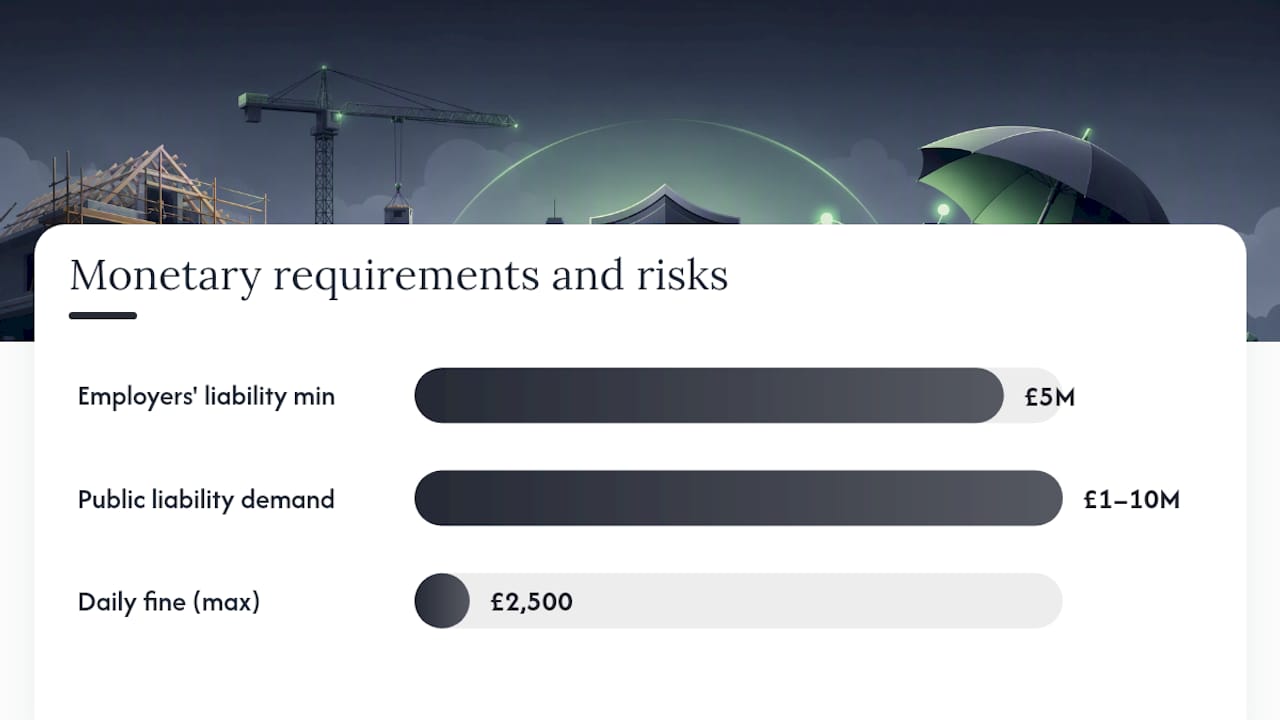
| Employers’ liability is compulsory | Required by law once you employ anyone, minimum £5 million cover, fines up to £2,500 daily for non compliance. |
| Public liability is effectively mandatory | Not a legal requirement, but clients and authorities routinely demand £1m to £10m before granting site access. |
| Add contract works and tools cover | Protects materials, unfinished work and equipment against theft, fire and storm damage on site. |
| Classify subcontractors correctly | Labour-only subcontractors fall under your employers’ liability; bona fide subcontractors need their own insurance. |
| Verify certificates directly with insurers | Request the policy schedule and confirm cover by contacting the insurer, not just the subcontractor. |
Table of Contents
- Employers’ liability and public liability insurance for builders UK
- Other cover a builder should consider carrying
- Getting subcontractor insurance right
- How to choose the right cover levels for your projects
- Verifying a builder’s or subcontractor’s insurance before work starts
- Ajcandsonbuilders: how we apply these standards on Liverpool projects
- What the industry gets wrong about builder insurance
- Sources
Employers’ liability and public liability insurance for builders UK
Employers’ liability insurance is the only mandatory insurance for builders under UK law, set out in the Employers’ Liability (Compulsory Insurance) Act 1969. It applies the moment you take on staff, apprentices or casual labour, covering compensation claims if a worker is injured or made ill through their work. The statutory minimum is £5 million, and firms operating without it face fines of up to £2,500 per day, along with the obvious exposure to an uninsured injury claim.
Public liability insurance for builders sits outside the law, but do not mistake that for optional. It covers claims from members of the public, clients or neighbouring property owners for injury or damage caused by your work, a dropped brick through a car windscreen, a trip hazard on a pavement, a burst pipe that floods next door. Most main contractors, housing associations and local authorities will not let you on site without proof of cover, and many set their own minimums for tenders, often £5m or higher.
- Legal requirement: employers’ liability only, and only once you employ someone.
- Contractual requirement: public liability, demanded almost universally by clients and authorities.
- Typical limits requested: £1m, £2m, £5m, occasionally £10m for larger schemes, per industry guidance on builders insurance.
The distinction matters for how you prioritise spend. Employers’ liability protects you from the law. Public liability protects your ability to actually work.
Other cover a builder should consider carrying
Beyond the two headline policies, several other covers close gaps that employers’ liability and public liability do not touch. Contract works insurance, sometimes called contractors’ all risks, covers materials, partly completed work and site plant against fire, theft, storm damage or vandalism while a job is in progress. Mortgage lenders and larger clients frequently insist on it before releasing stage payments, because an uninsured fire on a half built extension is a loss nobody wants to argue over afterwards.
Professional indemnity matters most if you offer design advice, specify structural elements like RSJs or lintels, or sign off calculations, since it covers claims arising from professional errors rather than physical damage. Tools and plant cover protects the kit that actually earns you money, a stolen mini digger or a smashed cement mixer can stall a job for weeks without it. Legal expenses cover, often bundled cheaply, pays for disputes over contracts or debt recovery.
- Contract works / contractors’ all risks: covers materials and unfinished work on site.
- Professional indemnity: covers design or specification errors.
- Tools and plant: covers theft or damage to equipment you rely on daily.
- Legal expenses: covers contract and payment disputes.
Insurers increasingly package these together, since combined construction policies covering public liability, employers’ liability, contract works and tools in one document are often cheaper and simpler to administer than buying each separately.
Pro Tip: Ask your broker for a combined package quote before buying policies piecemeal. Bundled construction insurance frequently costs less than the sum of its parts, and it is one less renewal date to track.

Getting subcontractor insurance right
How you treat subcontractors decides whether your employers’ liability policy actually pays out when something goes wrong. UK insurers draw a firm line between labour-only subcontractors, who work under your direction and count as your employees for insurance purposes, and bona fide subcontractors, who run their own business, use their own tools, and should hold their own insurance entirely. Misclassifying one as the other is one of the most common reasons employers’ liability claims get contested.
- Classify each subcontractor correctly before work starts, labour-only versus bona fide, based on how much control you exercise over their work.
- Collect written contracts setting out payment terms and responsibility for tools, materials and insurance.
- Request proof of insurance from every bona fide subcontractor, and keep copies with renewal dates noted.
- Check PAYE status where relevant, since HMRC treatment often mirrors how insurers view the relationship.
Pro Tip: Sole traders working genuinely alone are not legally required to hold employers’ liability cover, but they still carry public liability exposure and most clients will ask to see it before signing anything.
How to choose the right cover levels for your projects
Set your limits against real exposure, not habit. Start with a checklist: the value of the project, how much public access the site allows, any minimum stated in the client’s contract or the local authority’s tender documents, and your own claims history.
- Small domestic jobs: £1m to £2m public liability is often sufficient unless the client’s contract states otherwise.
- Larger renovations or commercial work: £5m is the common baseline, with £10m or more expected on bigger contracts or where a local authority is involved.
- Employers’ liability: never go below the statutory £5 million minimum, regardless of project size.
Wording matters as much as the limit. Check whether the policy covers hot works, demolition, working at height and plant use, since exclusions in these areas are among the most common reasons claims get refused. A loft conversion involving hot works for lead flashing, for instance, needs a policy that explicitly covers that activity, not one that assumes it is excluded as standard.
Verifying a builder’s or subcontractor’s insurance before work starts
Never take a claim of cover on trust, on your own jobs or anyone else’s you bring onto site.
- Request the certificate showing insurer name, policy number, cover type and expiry date.
- Ask for the policy schedule, not just the certificate, to confirm the actual limits and any exclusions.
- Contact the insurer directly using details from their official website, not a number given by the subcontractor, to confirm the policy is live.
- Red flags: certificates with no policy number, mismatched company names, or expiry dates within days.
- Record-keeping: store certificates centrally with renewal reminders set at least a month ahead.
Verifying cover this way reduces the risk of fraud and prevents a nasty surprise when a claim actually needs to be paid.
Ajcandsonbuilders: how we apply these standards on Liverpool projects
Ajcandsonbuilders carries the same insurance standards laid out above on every extension, loft conversion, brickwork and structural steel job across Liverpool and Merseyside. That means employers’ liability at or above the statutory minimum, and public liability set to match the scale of the project, whether that is a domestic rear extension or a larger commercial fit-out.
Homeowners and developers who hire a builder without checking cover are taking on risk they never priced in. Ask to see the certificate before work starts, not after something has gone wrong.
- What we provide: insurance certificates and policy details on request, alongside our full project portfolio.
- What you can check: cover limits, insurer name, and policy validity, directly, no pressure.
Pro Tip: Request the certificate and the client references at the same time. A builder confident in their cover is usually just as confident in their past work.
If you are planning a house renovation or an extension in Liverpool or Merseyside, get in touch for a free quote, and we will happily share our current insurance documentation as part of that conversation.
What the industry gets wrong about builder insurance
Most guidance on this topic treats employers’ liability and public liability as interchangeable line items on a checklist. They are not. One is a legal floor with a fixed £5 million minimum and a fine attached. The other is a market condition, set not by statute but by whatever the client, main contractor or council on the other side of the contract decides to demand that week.
That distinction changes how you should actually spend your time. Chasing the cheapest employers’ liability quote is a low-value exercise once you clear the £5 million minimum, since the statutory floor does the real work. Public liability deserves far more scrutiny, because the limit a client asks for, and the wording exclusions buried in the schedule, decide whether you can bid at all and whether a claim actually gets paid.
The subcontractor question is where most small firms come unstuck, not through dishonesty but through loose paperwork. Misclassifying a labour-only worker as bona fide feels harmless until a claim exposes the gap. Get the contracts and the classification right before you get the premium right.
Sources
- Employers’ Liability (Compulsory Insurance) Act 1969
- Public liability insurance for building contractors — CHAS Insurance
- Builders insurance guide — Focus Insurance
- Public liability insurance for building contractors — Howden Insurance