
Yes, if your extension touches a shared wall, builds along the boundary line, or involves excavating within 3 to 6 metres of your neighbour’s foundations. The Party Wall etc. Act 1996 governs this across England and Wales, and it sits entirely separate from planning permission or building regulations. You can have full planning consent and still be in breach of the law if you skip this step.
Statutory notice periods are fixed and non-negotiable:
- a fixed period before work starts on an existing party structure
- a fixed, shorter period before building a new wall on the boundary line or excavating near a neighbour’s foundations
Miss these windows and your build programme stalls before the first brick moves.
Key Takeaways
A party wall notice is legally required whenever an extension touches a shared wall, sits on the boundary line, or excavates within 3 to 6 metres of a neighbour’s foundations, and skipping it risks injunctions, invalid awards, and lengthy delays.
| Point | Details |
|---|---|
| Statutory basis | The Party Wall etc. Act 1996 applies across England and Wales, separately from planning permission and building regulations. |
| Notice periods are fixed | Serve two months ahead for party structure works, one month for boundary walls or excavations. |
| No reply means dispute | Silence after 14 days triggers a deemed dispute and formal surveyor appointment automatically. |
| Skipping notice is costly | Power v Shah shows an improperly served notice can invalidate the dispute process entirely, risking injunctions. |
| Get expert help early | Ajcandsonbuilders coordinates notice preparation, surveyor liaison, and build programming for extensions across Liverpool and Merseyside. |
Table of Contents
- Why extension party wall notice needed: the legal basics
- Notice types, contents, and statutory timing
- What happens once notice lands on your neighbour’s doormat
- The real cost of skipping the notice
- Your extension checklist: staying on schedule and compliant
- Who to bring in: surveyor, contractor, or solicitor
- Does the size of your extension change the rules?
- When you genuinely don’t need to serve notice
- What serving notice and appointing a surveyor actually costs
- Frequently asked questions
- Sources
Why extension party wall notice needed: the legal basics
The importance of a party wall notice comes down to one simple fact: the Act gives adjoining owners a legal right to know about, and respond to, work that could affect their property. Three situations trigger the requirement.
Party structure works (s.2) cover anything altering a shared wall, whether that’s cutting into it for beam supports, raising its height, or underpinning it. Line of junction works (s.1) apply when you build a new wall astride or up against the boundary, even if no existing wall is there yet. Excavations near foundations (s.6) catch digging within 3 metres of a neighbour’s foundations if your new work goes deeper, or within 6 metres if a 45-degree line drawn from the base of their foundation would be cut by your excavation.
In practice, this catches far more extensions than homeowners expect:
- A single-storey rear extension with new foundations 2.5 metres from next door’s wall
- Loft conversion works that chase cables or steels into a party wall
- A new garden wall built astride the boundary between two gardens
- Side-return extensions where trench foundations run close to a neighbour’s original footings
Many extensions fall within scope even when no wall is physically shared, simply because the dig is close enough to affect a neighbour’s foundations.
Pro Tip: If your extension involves piled foundations, deep basements, or “special foundations” of any kind, get a surveyor’s opinion before you draft a notice. The rules on what counts as adjacent excavation get technical fast, and getting it wrong here is the single most common reason notices are challenged later.
Notice types, contents, and statutory timing
Different works need different notices, and using the wrong one, or leaving out required details, can invalidate the whole process.
A party structure notice under section 3 covers direct work to a shared wall. A line of junction notice covers new boundary walls. An adjacent excavation notice covers digging near a neighbour’s foundations. Each has to be in writing, and each must be served on every adjoining owner, not just the one you happen to get on with.
A valid notice needs:
- The building owner’s full name and address
- Clear particulars of the proposed works, described precisely enough that a neighbour understands what’s happening
- The proposed start date
- Drawings and details of the foundations, where special or unusual foundations are involved
Section 3 also sets the practical boundaries you need to plan around. Notice must be served at least two months before work begins, and once served, it stays valid for twelve months. Serve too early and it lapses before you break ground; serve too late and you delay your own start date. Notices can be served by the building owner personally or by an authorised agent, such as a surveyor or architect, acting on their behalf. RICS professional guidance is blunt about the consequences of getting this wrong: deficiencies in how a notice is served can invalidate the entire statutory procedure, leaving you back at square one.
What happens once notice lands on your neighbour’s doormat
Your neighbour has three ways to respond, and each sends the project down a different path.
- Written consent. They agree to the works as described. No surveyor needed, no award, and you can proceed once the notice period has passed.
- Dissent. They formally object, usually because they want conditions attached, a schedule of condition recorded, or specific safeguards agreed.
- No response within 14 days. Silence is not consent. Under the Act, no reply after 14 days counts as a deemed dispute, which automatically triggers the formal surveyor process.
Once a dispute is deemed, you and your neighbour either agree on one surveyor between you, or each appoint your own. The surveyor(s) then produce a Party Wall Award, a binding document setting out the method of work, access arrangements, working hours, and who covers the surveyor’s fees. In practice, this process adds extra time beyond the statutory minimums, sometimes significantly more if the dispute is complex or surveyors are busy locally.
Dissent doesn’t kill your project. It usually just means the work proceeds under an award rather than by simple agreement, with extra time and cost baked in along the way.
The real cost of skipping the notice
Building owners sometimes assume that if a neighbour is unlikely to object, it’s safer just to get on with it. That assumption is expensive when it backfires.
Failing to serve notice properly leaves you exposed to injunctions, court claims in trespass, nuisance, or negligence, and a neighbour who’s entirely within their rights to stop your build mid-project. There are no direct statutory fines for skipping notice, but the civil remedies available to an aggrieved adjoining owner are typically far costlier than the process you tried to avoid.
The case of Power v Shah is the cautionary tale worth knowing. Courts found that where a section 3 notice hadn’t been properly served, the section 10 dispute resolution mechanism had no jurisdiction to operate, leaving the building owner without the Act’s usual protection and exposed to litigation instead.
Beyond the legal risk, defective notices commonly produce invalid awards, forcing you to restart the entire procedure from scratch. A dispute that surfaces mid-build routinely adds three to four months to a project timeline, on top of legal fees and additional surveyor costs that dwarf what proper notice would have cost upfront.
Your extension checklist: staying on schedule and compliant
- Confirm the Act applies. Check whether your works touch a party structure, sit on the boundary line, or excavate within the 3m/6m rules.
- Talk to your neighbours first. An informal conversation before the formal notice lands often prevents an automatic dissent.
- Prepare the correct notice. Match the notice type to your works and attach drawings where special foundations are involved.
- Serve in good time. Build the two-month (party structure) or one-month (line of junction/excavation) period into your programme, not as an afterthought.
- Allow for response time. Budget for the 14-day reply window and, if needed, surveyor appointment and award preparation.
- Keep every record. Save copies of notices, proof of service, and any correspondence with neighbours or surveyors.
Instruct a surveyor as soon as you suspect the Act applies, particularly for anything involving excavation near foundations. A solicitor becomes worth involving if a neighbour threatens an injunction or a dispute turns adversarial. Remember that notice lapses after twelve months if work hasn’t started, so timing your notice against your actual build schedule matters as much as serving it at all. Checking building regulations approval separately is still essential, since that process runs entirely independently of party wall procedure.
Who to bring in: surveyor, contractor, or solicitor
A party wall surveyor is usually your first call. They advise whether the Act applies to your specific works, draft or check the notice for you, record a schedule of condition on the neighbouring property before work starts, and issue the Party Wall Award if a dispute arises.

Your contractor then works within whatever the award specifies, programming works around agreed hours, access routes, and any protective measures the award requires for the neighbouring property. Reviewing your structural calculations alongside the surveyor’s requirements early avoids redesign later.
A solicitor becomes necessary only in specific circumstances: a dispute has escalated beyond what surveyors can resolve, a neighbour threatens or seeks an injunction, or a notice was served incorrectly and you need urgent legal advice on your position.
Does the size of your extension change the rules?
Not in the way most homeowners assume. A single-storey rear extension and a two-storey side extension are judged by the same tests: does the work touch a party structure, sit on the line of junction, or excavate within the statutory distances of a neighbour’s foundations?
A modest single-storey extension with shallow foundations well clear of the boundary might avoid the Act entirely. A larger, two-storey extension with deeper foundations close to next door almost always falls within it, simply because bigger builds tend to dig deeper and sit closer to boundaries. Scale matters indirectly, through foundation depth and proximity, not because the Act treats larger projects differently in principle.
Loft conversions deserve a specific mention here. Even though they don’t touch ground level at all, cutting into a party wall for structural steels or running new chimneys through a shared chimney breast still counts as party structure work under section 2. Basement extensions sit at the other extreme: their depth and proximity to neighbouring foundations mean they trigger the Act almost without exception, and usually warrant a surveyor’s involvement from the earliest design stage rather than after drawings are finished.
When you genuinely don’t need to serve notice
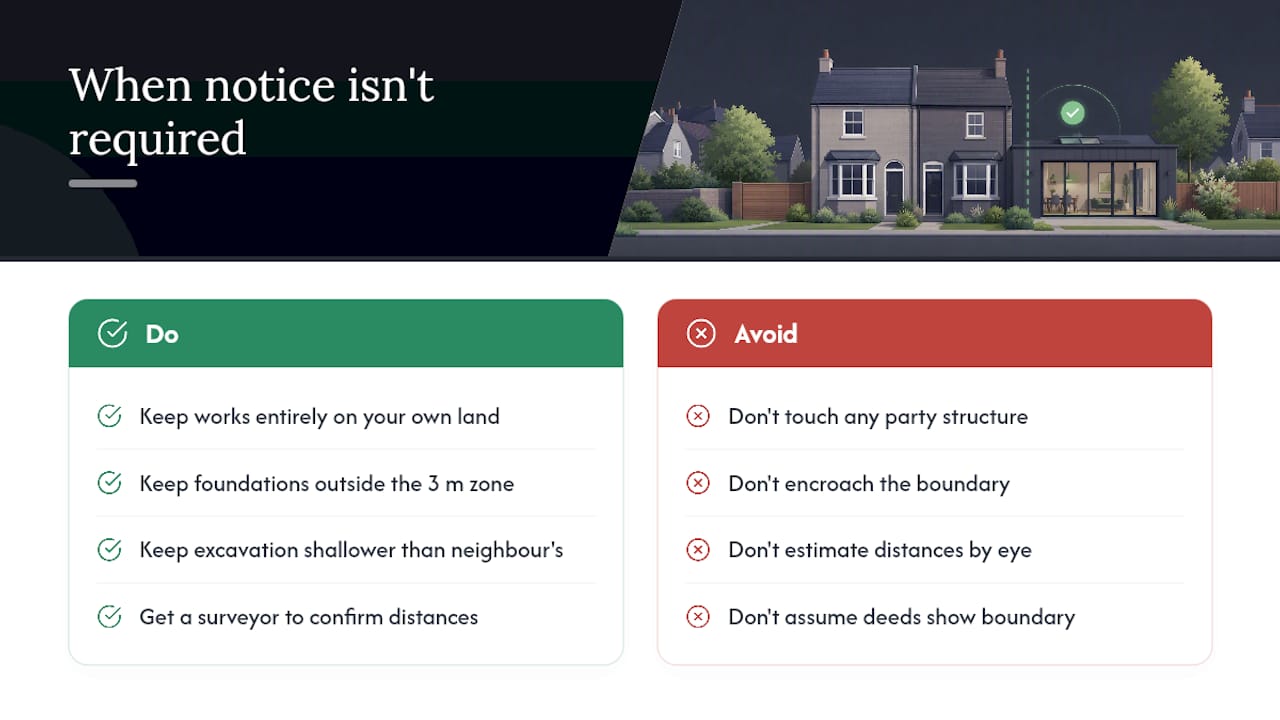
Not every extension needs one. If your new structure sits entirely on your own land, set back from the boundary far enough that no shared wall, line of junction, or foundation proximity issue arises, the Act simply doesn’t apply.
A rear extension built well within your own boundary, with foundations that stay outside the 3m/6m excavation zones, falls outside the Act’s scope entirely. The same goes for internal alterations that don’t touch any party structure, such as reconfiguring rooms away from a shared wall, or replacing a roof that doesn’t involve the party wall at its junction.
The distance and depth rules do the real work here. If your excavation stays shallower than the neighbour’s foundations and remains outside 3 metres, or sits beyond 6 metres regardless of depth, you’re outside section 6 territory. Building work confined entirely to your own structure, with no shared wall and no boundary encroachment, generally sits outside the Act too.
That said, “set back from the boundary” needs to be measured properly, not estimated by eye. Homeowners sometimes assume they’re clear because a wall “looks like” it’s a metre or two inside their boundary, only to find a site survey puts them well within the trigger zones. When in doubt, get a surveyor to confirm distances before assuming you’re exempt, particularly on older properties where boundary lines aren’t always where deeds suggest.
What serving notice and appointing a surveyor actually costs
Serving notice itself carries no fee. Anyone can draft and post a compliant notice at no cost beyond their own time, provided it contains the correct particulars.
Costs arise once a surveyor becomes involved, and this happens in two scenarios. If you instruct a surveyor from the outset to check whether the Act applies and prepare your notices correctly, you’re paying for professional time upfront, which varies depending on the complexity of the works and the surveyor’s experience. If your neighbour dissents or fails to respond, triggering the deemed dispute process, surveyor fees escalate because now you’re paying for schedules of condition, site visits, and drafting a formal award, sometimes for two surveyors rather than one if you and your neighbour don’t agree on a single appointee.
Under the Act, the building owner typically covers reasonable surveyor fees for both sides in a dispute, which is worth factoring into your budget from the planning stage rather than discovering it mid-project. A solicitor’s involvement adds further cost, but only becomes necessary in the smaller number of cases that escalate toward injunction risk or contested awards.
Weighed against the alternative, a delayed project, an invalid award, or defending an injunction, the professional fees for getting notice right the first time are consistently the cheaper path.
Why following the Act protects both sides
We’ve seen how much smoother an extension runs when notice goes out early and neighbours are talked to directly before the formal paperwork lands. Ajcandsonbuilders has worked alongside surveyors on enough extensions and party wall situations to know that the projects which stay on schedule are the ones where statutory timings were built into the programme from day one, not squeezed in as an afterthought.
If you need help planning your extension and party wall procedure
Getting notice, drawings, and timing right on your own is doable, but it’s also where most delays creep in, especially if you’re juggling a full-time job alongside managing surveyors and contractors. Ajcandsonbuilders works through this process alongside you rather than handing you a checklist and walking away: we help plan the build programme around statutory notice periods, prepare accurate particulars and drawings for your notice, and coordinate directly with surveyors so nothing stalls waiting on paperwork.

If you’re planning a house extension in Liverpool or Merseyside, get in touch for a free quote and we’ll talk through what your specific project needs, including whether the Act applies to your works and what timescale to build in before you set a start date.
Frequently asked questions
Do I need a party wall notice for a single-storey extension? Only if the works touch a party structure or the foundations fall within the 3m/6m excavation rules. Many single-storey rear extensions do trigger the Act simply through foundation proximity, even without touching a shared wall.
What happens if I start work without serving notice? You risk an injunction stopping work mid-build, potential claims in trespass or nuisance, and an invalid dispute process if issues arise later, as the Power v Shah case demonstrates.
How long does the party wall notice process take for an extension? Straightforward consent can clear within the one or two month statutory notice period. A dispute requiring surveyor appointment and an award typically adds several weeks to a few months on top.
Can my neighbour refuse to let me build my extension? No. Dissent triggers the formal award process rather than blocking lawful work outright, though it usually adds time and cost before you can start.
Who pays for the party wall surveyor? The building owner typically covers reasonable surveyor fees for both parties when a dispute arises, which is worth budgeting for from the planning stage.
This article is general information, not a substitute for advice from a qualified lawyer. Consult a qualified legal professional about your own circumstances before acting on anything here.
Sources
- Gov
- Party Wall etc. Act 1996 — section 3 (party structure notices)
- Party wall legislation and procedure — RICS professional standard
- The Party Wall Act: do you have to give notice? — JMW