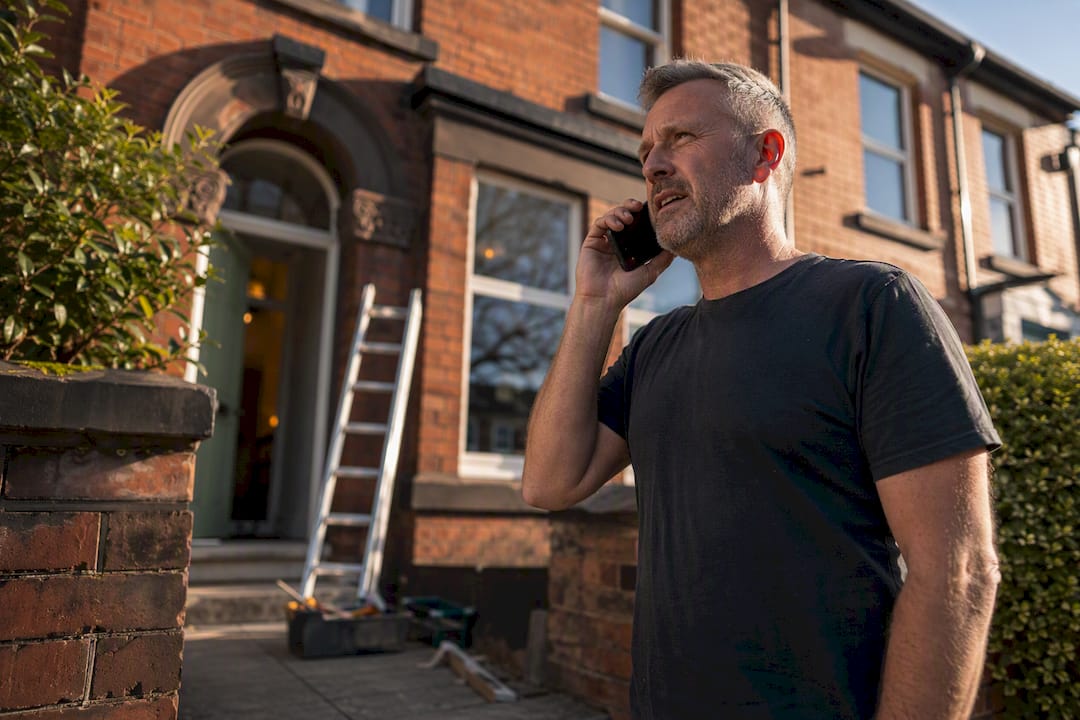
Before you let anyone start work on your house, do four things: check their insurance certificate, verify trade-body membership on the organisation’s own register, get three written quotes, and visit a job they’ve recently finished. Skip any one of these and you’re gambling with money you can’t easily get back.
This matters because the checks themselves are quick. What’s not quick is untangling a half-finished extension or chasing a trader who’s stopped answering the phone. The Federation of Master Builders recommends at least three like-for-like quotes before you commit to anyone. Its “Check a Member” tool lets you confirm claims in minutes rather than taking a business card at face value. TrustMark’s government-endorsed register and Companies House both offer the same kind of instant verification.
- Ask to see current public liability insurance, then phone the insurer to confirm it’s live.
- Search the builder’s name on the relevant trade register (FMB, TrustMark, Gas Safe, NICEIC), not just their website.
- Request two or three references you can call, plus an address of a finished job you can view.
- Get everything in writing: quote, scope, dates, payment schedule.
Key Takeaways
Avoiding a cowboy builder comes down to verifying insurance and trade membership directly with the source, getting everything in writing, and matching your checks to the size of the job.
| Point | Details |
|---|---|
| Verify, don’t trust logos | Check FMB, TrustMark, Gas Safe or NICEIC membership on the organisation’s own register, not a website badge. |
| Confirm insurance by phone | Call the insurer named on the certificate to rule out lapsed or forged public liability cover. |
| Get three written quotes | Compare identical scopes, materials and dates, not just a bottom-line price. |
| Pay in stages, not upfront | Keep deposits to 10 to 25% and tie further payments to completed milestones. |
| Choose a vetted local team | Ajcandsonbuilders offers documented quotes, staged payments, and a visitable Merseyside portfolio. |
Table of Contents
- How to avoid cowboy builders with a clear pre-hire process
- Where to find vetted builders you can actually trust
- What documents should you ask a builder for?
- What should be in a builder’s quote and contract?
- What are the biggest red flags of a rogue builder?
- What should you do if a builder disappears or does bad work?
- How much extra vetting does a big project need?
- Want a builder you don’t need to interrogate?
- Frequently asked questions
- Sources
How to avoid cowboy builders with a clear pre-hire process
Most disputes trace back to a rushed start. Before you approach anyone, write down exactly what you want done, including materials and finishes, so every quote answers the same brief. Vague scoping is how homeowners end up comparing a £9,000 quote against a £15,000 one without realising they cover different work entirely.
Before you hire:
- Get three written quotes based on the identical scope.
- Visit at least one recent, comparable job each builder has completed.
- Agree a start date, a realistic completion date, and what happens if either slips.
- Confirm the payment schedule ties to visible milestones, not the calendar.
Once work starts, keep a simple paper trail: dated photos before, during, and after each stage, plus copies of every email or text exchange with the builder. This costs nothing and becomes the single most useful thing you own if a disagreement arises later. Walk the site every few days rather than waiting for a big reveal at the end, and query anything that looks rushed or doesn’t match the quote.
Pro Tip: Ring the insurer named on the certificate directly rather than emailing the builder for confirmation. A five-minute call reveals a lapsed or forged policy that a scanned PDF never will, according to guidance from Less.
Where to find vetted builders you can actually trust
Start with registers that vet tradespeople before they’re listed, rather than review sites anyone can post on.
- TrustMark runs a government-endorsed register of tradespeople who’ve passed technical and financial checks, a solid first stop for most home improvement work.
- FMB members are checked before joining and can supply contract templates alongside proof of membership.
- Which? Trusted Traders applies its own vetting and monitors ongoing customer feedback, useful for cross-referencing a name you’ve already found elsewhere.
- Your local council’s building control team, sometimes via LABC Front Door, can point you towards traders whose work has passed inspection locally, as Dartford Borough Council advises residents to check.
Treat every directory listing as one data point, not proof. A five-star review tells you nothing about current insurance or whether the business still exists under that name. Pair any online recommendation with a documentary check before you pick up the phone.
What documents should you ask a builder for?
Insurance comes first. Ask for a current public liability certificate, generally recommended at a minimum of £2 million cover for most domestic projects according to industry guidance, and an employer’s liability certificate if they’ll have staff on site. Don’t stop at seeing the document; call the insurer listed on it. This single step catches more fraud than any amount of website browsing.
Next, verify trade-body and statutory registration:
- FMB, TrustMark membership, checked on the organisation’s own online finder rather than trusting a logo on a van.
- Gas Safe Register for anyone touching gas appliances or pipework, a legal requirement, not an optional extra.
- NICEIC for electrical work.
- CSCS cards for individual site operatives on larger jobs.
- Companies House to confirm the business is registered, how long it’s traded, and whether directors have a history of dissolved companies.
Ask for two or three references and actually call them. A trader who hesitates to hand over a certificate, dodges a straight question about insurance, or won’t give you a single past client’s contact detail has told you everything you need to know.
Pro Tip: Scale your checking to the job. A fascia replacement doesn’t need the same scrutiny as a two-storey extension involving structural steel, where you’d want to see evidence of managing comparable structural risk before signing anything.
What should be in a builder’s quote and contract?
A proper written quote itemises the scope of work, named materials and brands, a start date and a realistic completion date, whether VAT is included, and anything explicitly excluded. If two quotes for the “same” job differ by thousands of pounds, the gap is usually hiding in what’s excluded.
The contract needs to go further than the quote:
- A clear process for change orders, so extra costs are agreed in writing before work happens, not invoiced afterwards.
- A retention clause (commonly 5 to 10%) held back until snagging is complete.
- A named route to dispute resolution or ADR if things go wrong.
- What happens if the builder becomes insolvent partway through.
On payment, a deposit of 10 to 25% is standard for larger projects; a very large upfront deposit is a warning sign, as FMB guidance notes. Tie every subsequent payment to a completed, visible milestone rather than a date on the calendar, and pay by card or bank transfer rather than cash, both for the paper trail and because card payments carry stronger buyer protection through Section 75 or chargeback.
What are the biggest red flags of a rogue builder?
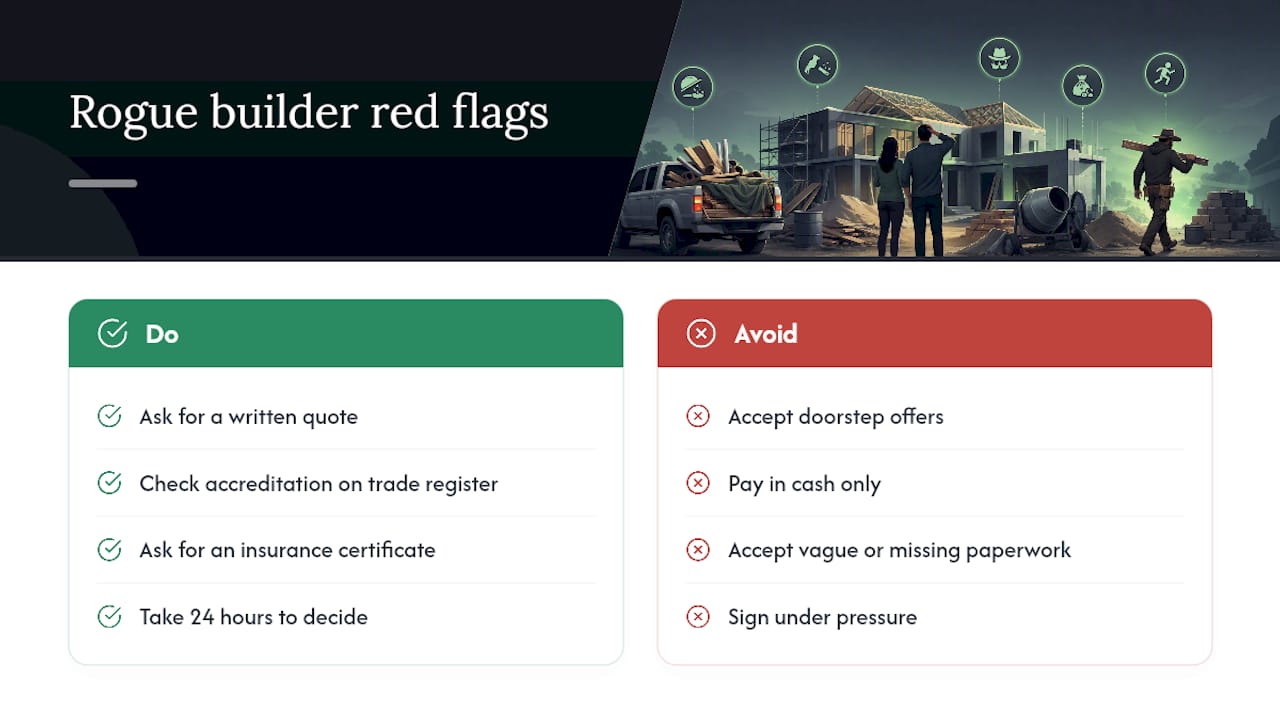
Which? identifies five recurring warning signs among rogue traders: unsolicited doorstep approaches, insistence on cash, vague or missing paperwork, quotes that undercut everyone else by an implausible margin, and pressure to decide on the spot. Any one of these should slow you down; two or more, and you should walk away.
Pressure tactics tend to follow a pattern: a trader claims they’re “already in the area” with materials left over from another job, offers a discount that expires the moment they leave, or warns the price rises tomorrow if you don’t sign today. Real Homes catalogues similar behaviour, including no fixed business address and an unwillingness to provide references.
Rogue traders rely on speed. The moment a homeowner asks for a written quote, an insurance certificate, or twenty-four hours to think it over, most of them disappear on their own.
Never take a claimed accreditation on trust. A logo on a van or a name dropped in conversation means nothing until you’ve checked it on the trade body’s own register yourself.
What should you do if a builder disappears or does bad work?
Stop any further payments the moment you suspect something’s wrong, and start gathering evidence immediately.
- Photograph the work as it stands, and gather every invoice, email, text and the original quote and contract.
- Write a formal, dated complaint to the builder, giving a reasonable deadline to respond.
- Report the trader to Trading Standards and get advice from Citizens Advice on your specific case.
- Contact your insurer if the property is damaged, and the police if you suspect deliberate fraud rather than poor workmanship.
If the builder won’t cooperate, look at Alternative Dispute Resolution schemes, the small claims court for amounts under the relevant limit, or a Section 75 claim if you paid any part by credit card, as Which? recommends. For anything structural or safety-related, get an independent surveyor or another builder to produce a written report before you go further. That report becomes your strongest piece of evidence.
How much extra vetting does a big project need?
Vetting should scale with what’s at stake. A gutter repair and a full two-storey extension carry entirely different risk profiles, and treating them the same wastes time on the small job while leaving you dangerously exposed on the large one.
For structurally sensitive or high-value work, go further than the standard checks: confirm the contractor has handled comparable structural projects before, ask any designer involved for professional indemnity insurance, and look for UKAS-accredited certification where relevant to the trade. Our guide on how a property manager selects a builder sets out a fuller due diligence framework worth borrowing even for a single-project homeowner.
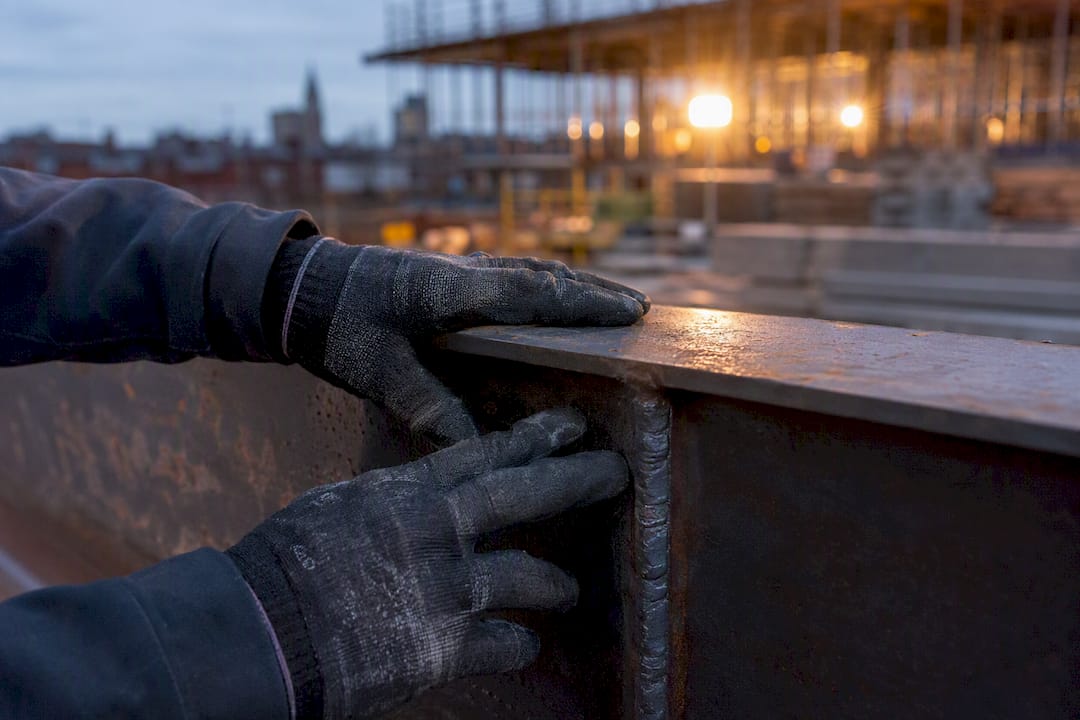
Pro Tip: If you can only escalate one check for a major job, make it the insurance phone call. It exposes forged or lapsed cover faster than a Companies House search or a trade register lookup ever will.
A builder’s perspective on trust and communication
Most disputes I’ve seen didn’t start with bad workmanship. They started with a homeowner who never asked to see a certificate, and a builder who never volunteered one. On Merseyside jobs, access and parking often shift week to week on terraced streets, and the clients who flag that early, in writing, save everyone a headache later. One extension I recall went smoothly purely because the homeowner photographed every stage and emailed a two-line update after each visit. When a small dispute over a change order came up, there was no argument. The record spoke for itself.
Want a builder you don’t need to interrogate?
Ajcandsonbuilders is the alternative to gambling on an unverified trader: full insurance, a documented quote and staged payment plan, and a Liverpool and Merseyside portfolio you can actually go and look at before you commit a penny.

We work across extensions, loft conversions, brickwork, rendering, and structural steelwork, and every job starts with a written scope and schedule rather than a verbal promise. Browse our completed projects or read testimonials from recent clients before you get in touch. If you’re planning a renovation, our house renovation page outlines what to expect from first survey to final snagging. To get an accurate quote, send us the scope of work, rough dimensions or photos of the space, and your ideal timeline, and we’ll arrange a site visit to confirm the detail in person.
Frequently asked questions
How do I avoid cowboy builders when I’ve never hired a contractor before?
Follow the same four checks every time: verified insurance, checked trade-body membership, a written quote, and a visit to a finished job. First-time homeowners who skip the site visit are the group most often caught out.
What’s the biggest single warning sign of a rogue trader?
Pressure to decide immediately, especially combined with a cash-only request or an unusually low price, according to Which?. Genuine tradespeople expect you to compare quotes and take time.
Is a builder listed on a review site automatically safe to hire?
No. Reviews say nothing about current insurance status or trade-body membership. Use them alongside, not instead of, the documentary checks above.
How much deposit is reasonable for a home extension?
What should I do first if I think I’ve hired a cowboy builder?
Stop further payments, photograph the current state of the work, and gather every document you have before contacting Trading Standards or Citizens Advice.
Sources
- How to choose a builder (FMB)
- Rogue traders: 5 red flags to look out for (Which?)
- How to avoid cowboy builders – Dartford Borough Council
- TrustMark
- How to choose a builder (Less)