Standard home insurance usually does not cover structural renovation work, and telling your insurer only after work starts can invalidate your whole policy. Before the first brick moves, do three things: notify your insurer in writing, check your contractor’s own liability cover, and hold off on works if your insurer has not confirmed cover in writing.
- Write to your insurer describing the scope and dates of the works.
- Ask your contractor for proof of public liability insurance.
- Wait for written confirmation before work begins.
- Get the insurer’s confirmation as an email or letter, not a phone call summary.
Pro Tip: Save your contractor’s insurance certificate and your insurer’s written confirmation in the same folder as your building contract. If a claim ever arises, that paper trail is what settles it.
Key Takeaways
Home insurance during renovation depends on declaring the works in writing and matching the policy type to the scope, from minor works cover through to a standalone contract works policy.
| Point | Details |
|---|---|
| Declare works in writing | Get insurer confirmation before work starts, referencing the exact scope. |
| Match policy to project scale | Structural work usually needs a contract works policy or dwelling under construction endorsement. |
| Check unoccupancy limits | Cover can lapse after around 60 days empty unless the insurer is told. |
| Reassess after completion | Update your rebuild valuation and sum insured once works finish. |
| Choose a coordinated contractor | AJC & Son Builders provides insurance certificates and completion documentation to support your cover. |
Table of Contents
- Do you need home insurance during renovation, and what type?
- Does your existing buildings insurance cover renovation work?
- What does renovation insurance cover, and what’s usually excluded?
- How do you arrange renovation cover with an insurer or broker?
- How much does renovation insurance cost?
- How do you choose the right renovation insurance policy?
- What should you do once renovation work is finished?
- How should you coordinate insurance with your builder?
- How AJC & Son Builders takes the insurance guesswork out of renovating
- Frequently asked questions
- Sources
Do you need home insurance during renovation, and what type?
Most homeowners assume their buildings policy stretches to cover whatever work they have planned. It usually doesn’t, once that work goes beyond cosmetic decoration. There are three products you’re likely to encounter:
- Minor works cover — often built into a standard buildings policy, covering things like repainting or replacing a kitchen without touching load-bearing walls.
- Contract works (builders risk) insurance — a standalone policy covering the build itself: materials, existing structure damage, and site risks during active construction.
- Dwelling under construction endorsement — an add-on to your existing buildings policy that extends cover for the duration of a specific project.
Structural work (extensions, loft conversions, removing a supporting wall) almost always needs one of the latter two. Many of these packages bundle in public liability cover, which protects you if a visitor or neighbour is injured or their property is damaged because of your works.
Does your existing buildings insurance cover renovation work?
Rarely, once the works are structural. In the UK, standard buildings insurance does not cover elective home renovations, and extensive structural work like extensions or loft conversions typically requires an extension to your existing policy or a specialist renovation policy. Cosmetic jobs tend to sit under a “minor works” allowance, but insurers rarely define that term precisely, so it’s safer to assume anything structural falls outside standard cover unless the insurer accepts it in writing.
The exclusions homeowners trip over most often:
- Theft of building materials left on site
- Structural alteration without prior agreement
- Extended unoccupancy while the property is being worked on
- Collapse or damage caused directly by the works themselves
Not declaring your project is the costlier mistake. It can invalidate the whole buildings policy, not just the claim connected to the renovation.
Pro Tip: Never treat a verbal “that should be fine” from a call centre as confirmation. Ask for it in writing, referencing the specific scope of works, before the skip arrives.
What does renovation insurance cover, and what’s usually excluded?
A decent contract works or renovation policy typically bundles together cover for the existing structure, the new works themselves, materials on site or in transit, public liability, and sometimes alternative accommodation if the property becomes unlivable mid-project. That combination is what separates it from a bare buildings policy.
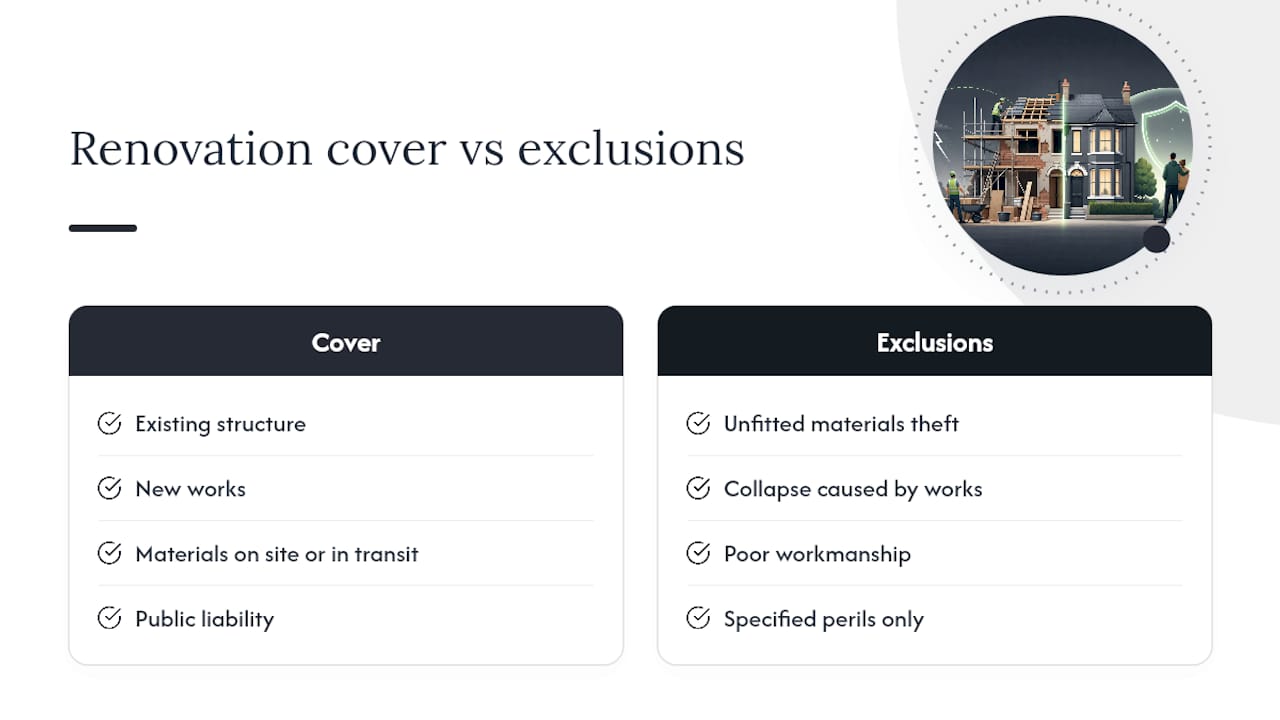
Exclusions catch people out repeatedly. Watch for theft of materials that haven’t yet been fitted (often excluded unless specified), collapse caused by the works, poor workmanship, cover limited to “specified perils” only, and strict limits on how long the property can sit unoccupied. Which? found that few buildings and contents policies include accidental damage cover for renovations as standard, which means many homeowners are paying for cover they assume exists and doesn’t.
A standalone builders risk policy typically covers materials on-site and in transit, which is exactly what cheaper endorsements tend to leave out.
How do you arrange renovation cover with an insurer or broker?
Insurers and brokers need specific information before they’ll quote, so gather it before you call:
- Contractor details, including their public liability and, where relevant, employers’ liability insurance.
- The value and scope of works, ideally taken from your building contract or quote.
- Start and end dates for the project.
- Whether the property will be unoccupied at any point, and for how long.
Timelines vary. A broker can often turn round a quote or endorsement within a few days; bespoke policies for larger or more unusual projects take longer, sometimes a couple of weeks.
Have these questions ready:
- Is public liability included, or does it need adding separately?
- What happens to cover if the property is empty for part of the project?
- Are materials covered while they’re in transit or stored off site?
Many home insurers limit cover for unoccupied properties to no more than 60 days, so if you’re moving out during works, flag this early rather than assuming your policy stretches to cover it.
How much does renovation insurance cost?
Price moves on a handful of levers: the value of the works, whether the job is structural or cosmetic, how long the project runs, whether the property will be unoccupied, and the credentials of your contractor. A vetted, insured contractor with a solid track record tends to bring the premium down; an unverified one pushes it up because the insurer is carrying more risk on workmanship and site security.
Duration matters more than most homeowners expect. A three-month kitchen extension prices very differently from a nine-month whole-house renovation, even at similar build values, because the exposure window is longer.
Pro Tip: Fitting temporary site alarms, secure storage for materials, and scheduling works to minimise how long the property sits empty can all shave money off a quote. Ask your broker which of these they actually price for.
How do you choose the right renovation insurance policy?
Run every quote against the same checklist:
- Coverage scope: does it separate existing structure, new works, and materials clearly?
- Is public liability included, and at what limit?
- What’s the policy period, and does it match your build timeline with some margin?
- What’s the sum insured and excess, and do they reflect the real project value?
- How is unoccupied cover handled, and for how long?
- Is the claims process explained clearly, with contact details for site incidents?
- Will the insurer provide the full policy wording or a downloadable PDF before you commit?
Red flags worth walking away from: vague language around materials cover, no clear answer on unoccupancy, a blanket exclusion for collapse during works, or an insurer that won’t put its confirmation in writing.
- Ask for the policy wording document, not just a summary page.
- Ask directly what happens if the contractor doesn’t finish on schedule.
- Confirm whether the policy follows you if you switch contractors mid-project.
BIBA recommends treating insurance as a project budget line comparable to planning permission or building-regulation costs rather than an afterthought once quotes are in.
What should you do once renovation work is finished?
Completion is when a second, quieter risk appears: your rebuild cost has likely gone up, and your buildings sum insured hasn’t caught up with it.
- Get a revised rebuild valuation, especially after adding floor area via an extension or fitting higher-spec materials.
- Notify your insurer in writing with the new figure and completion date.
- Keep receipts, contractor certificates, and completion documentation together.
Significant improvements often increase total rebuild cost, and failing to update the sum insured can leave you underinsured if a total loss occurs. Do this within weeks of completion, not at your next renewal.
How should you coordinate insurance with your builder?
Ask your contractor for proof of public liability insurance and, if they employ staff on site, employers’ liability cover, before signing anything. This isn’t paranoia. Homeowners often assume a contractor’s cover automatically protects their interests, but you remain responsible for keeping your own buildings insurance valid throughout the project.

On managed projects, AJC & Son Builders typically handles site security, secures materials storage, and keeps material receipts and completion certificates ready to hand over. That paperwork is exactly what insurers ask for when confirming cover or settling a claim.
At handover, expect: a signed completion certificate, material receipts, and a written record of what was built and when. Understanding contractual responsibilities helps here too, particularly on what a building contract should specify about insurance obligations.
Pro Tip: Ask your builder for their insurance certificate before the deposit, not after the skip arrives. A contractor who hesitates to provide one is telling you something.
A builder’s view on where renovation cover goes wrong
The same three mistakes turn up on site again and again: homeowners who never told their insurer, materials left unsecured overnight, and a contractor’s cover that turns out not to exist. None of these are hard to avoid. Work through the checklists above before you sign anything, and if a policy document still confuses you, ask a broker or a trade body rather than guessing.
How AJC & Son Builders takes the insurance guesswork out of renovating
There’s a real gap between comparing renovation policies yourself on a site like Confused.com and having a contractor who already builds the paperwork into the project. AJC & Son Builders manages Liverpool and Merseyside renovations with exactly that gap in mind: we hold our own public liability cover, secure materials on site, and hand over receipts and completion certificates that your insurer will actually accept as evidence.

If you’re planning an extension, loft conversion, or full renovation and want a contractor who coordinates that side of things rather than leaving you to chase paperwork mid-project, get a free quote through our house renovation service page. You’ll still need to confirm your own insurance arrangements directly with your insurer. We simply make sure you’ve got the evidence ready when they ask for it.
Frequently asked questions
Do I have to tell my insurer if I’m renovating?
Yes. Not declaring structural works risks invalidating your entire buildings policy, not just the claim tied to the renovation itself.
Will my contractor’s insurance cover my house during the build?
No. Their public liability or employers’ liability cover protects third parties and their own work. Your buildings insurance still needs to be in place separately.
How long does it take to get renovation cover in place?
A broker can often arrange an endorsement within a few days; bespoke contract works policies for larger projects can take longer.
Do I need renovation insurance for a small cosmetic job?
Usually not, if it falls under your policy’s minor works allowance. Get written confirmation from your insurer if you’re unsure whether your project counts as minor or structural.
This article is general information, not a substitute for advice from a qualified financial advisor. Consult a qualified financial professional about your own circumstances before acting on anything here.
Sources
- Will your insurance cover home improvements? – Which?
- Confused
- Home Renovation – BIBA
- Builders Risk vs. Homeowners Insurance: Do You Need Both? (2026) – ConstructionCoverage
Keep every policy wording document and written confirmation you receive.