
The quickest route to maximising profit from a house refurbishment is matching your scope to what buyers in that postcode will actually pay for, then prioritising visible, buyer-facing improvements over luxury extras. A competent full refurbishment commonly adds around 8–15% to a UK property’s value, but the same work can return £80,000 in one postcode and £20,000 in another. The rule of thumb that protects margin: target projects that move a property up one or two interior-condition tiers, from ‘dated’ to ‘good’, rather than chasing a show-home finish.
The levers that matter most, in order:
- Match scope to postcode demand — developer-active areas compress your uplift; buyer-averse areas amplify it.
- Prioritise visible, buyer-facing works — kitchen, bathroom, decoration, flooring, and an extra WC deliver the strongest £-per-£ return.
- Model before you build — run a scenario comparison on comparables before committing to finance or contractors.
- Protect margin with a proper cost estimate — materials, burdened labour, overhead recovery, and a realistic contingency of 10–30%.
Table of Contents
- What each refurbishment level costs and returns in 2026
- Which improvements actually move the sale price?
- When will a refurbishment pay, and when should you sell as-is?
- How to estimate costs properly and protect your margin
- How to phase work and protect your schedule
- Tax implications you need to include in your refurbishment model
- Key takeaways
- What site experience actually teaches you about refurbishment profit
- Ajcandsonbuilders: local refurbishment delivery across Liverpool and Merseyside
- Useful sources and tools
What each refurbishment level costs and returns in 2026
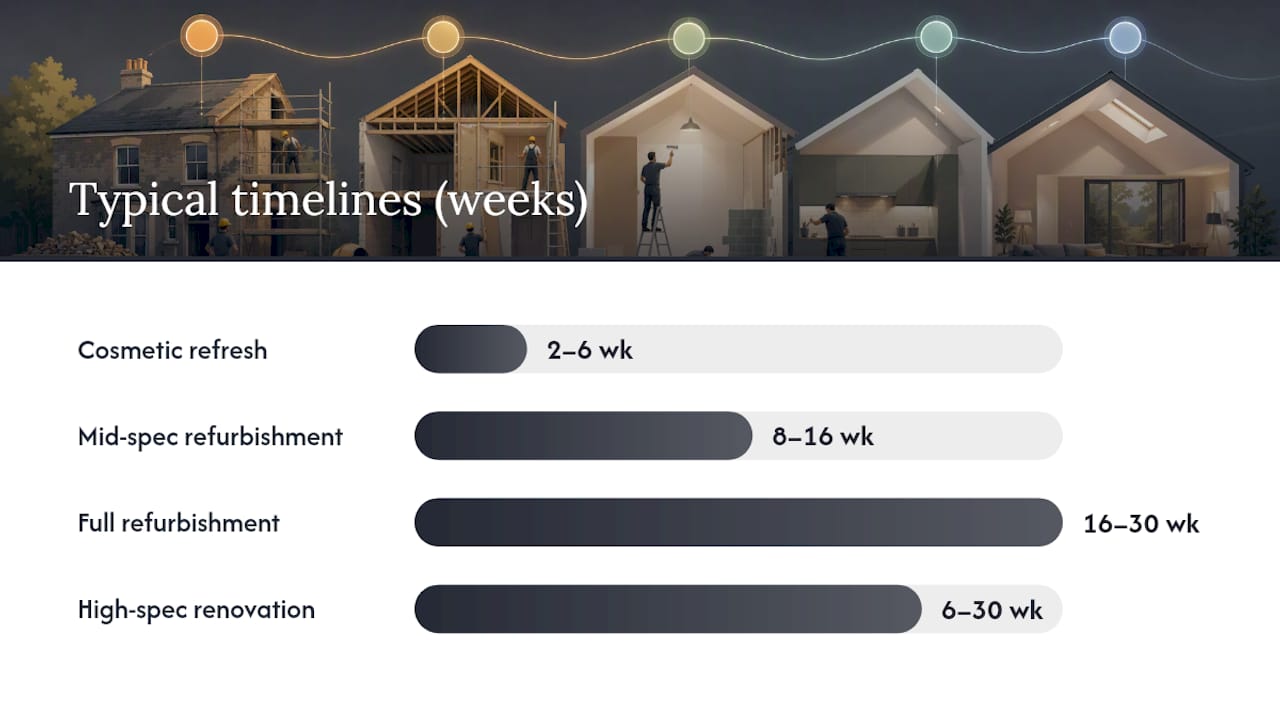
Industry data for 2026 shows four distinct refurbishment levels, each with a different cost band, timeline, and typical uplift. Choosing the wrong level for your postcode is the single most common reason a refurbishment fails to return its cost.
| Refurbishment level | Typical 2026 build cost | Typical uplift | Timeline | Where it pays best |
|---|---|---|---|---|
| Cosmetic refresh | — | 2–5% of property value | 2–6 weeks | Most postcodes; especially pre-sale preparation |
| Mid-spec refurbishment | — | 6–10% | 8–16 weeks | Buyer-averse areas; dated stock with good bones |
| Full refurbishment | — | 8–15% | 16–30 weeks | Structurally sound properties in strong demand areas |
| High-spec renovation | — | Variable; rarely proportionate | 6 weeks to 30 weeks | Prime postcodes only; owner-occupier-led markets |
The cosmetic and mid-spec tiers consistently deliver the strongest £-per-£ return. Full refurbishments can generate the largest absolute uplift, but the margin compresses quickly once build costs exceed £100,000 on a mid-range property.
Pro Tip: Avoid high-spec finishes unless your comparable evidence shows buyers in that postcode are already paying a premium for them. Designer kitchens and bespoke joinery rarely recover their cost outside prime areas.
Which improvements actually move the sale price?
Buyer perception drives value, not build cost. The interventions that shift buyer-panel reaction most reliably are:
- Downstairs WC addition — where one is missing, adding a downstairs WC is often the single highest-ROI intervention in the property. The build cost is modest; the buyer-panel reaction is disproportionately positive.
- Decoration — fresh, neutral paint throughout is the cheapest perception upgrade available. Low-cost updates such as paint, hardware swaps, and improved lighting consistently improve buyer perception at minimal spend.
- Kerb appeal and garden — exterior and curb-appeal projects rank at the top of 2026 cost-vs-value analyses, often outperforming large interior remodels on percentage ROI. A tidy front garden, repainted render, and clean guttering cost little and photograph well.
Pro Tip: Specify mid-range products with broad appeal: white sanitaryware, neutral stone-effect tiles, and anthracite grey fixtures. These read as premium without the premium price tag, and they appeal to the widest buyer panel.
When will a refurbishment pay, and when should you sell as-is?
Not every property rewards refurbishment spend. Three diagnostic questions help you decide:
1. What are comparable ‘done’ properties selling for versus ‘dated’ ones? Search Rightmove and Zoopla for sold prices in the same street or postcode over the past six months. If the condition discount is less than your estimated refurb cost plus a 20% margin, the numbers do not work.
2. How long are refurbished properties sitting on the market? Long sale times in ‘done’ condition suggest buyer demand is weak regardless of presentation. In developer-active postcodes, trade buyers are already pricing in the uplift, leaving little room for a retail refurbishment margin.
3. Are there non-construction value-adds you have not yet secured? Lease extensions, title fixes, and securing planning permission can add significant value without construction costs. On a flat with a short lease, extending the lease before sale frequently adds more uplift than a full refit.
Decision checklist:
- Condition discount exceeds refurb cost plus 20% margin → refurbish.
- Condition discount is marginal or developer-active market → sell as-is or to a trade buyer.
- Short lease, title issue, or planning potential → secure the paper value first, then reassess.
How to estimate costs properly and protect your margin
Underpricing a refurbishment is where most profit is lost. A reliable estimate rests on three pillars.
Pillar 1 — Materials: List every line item with quantities. Apply a waste factor of 10–15% on materials such as tiles and timber to avoid mid-project shortfalls.
Pillar 2 — Burdened labour rate: The contractor pricing framework distinguishes between a bare hourly rate and a fully burdened rate that includes employer costs, insurance, tools, and vehicle overhead. Using a bare rate understates true labour cost by 30–40% on most jobs.
Pillar 3 — Overhead recovery: Every project must carry a share of fixed business costs. A simple formula: divide annual fixed overheads by billable hours to get an overhead-per-hour figure, then add it to the burdened labour rate.
| Cost element | Typical inclusion | Common omission risk |
|---|---|---|
| Materials | Quantities × unit price | Waste factor (10–15%) |
| Labour | Burdened rate × hours | Employer costs, insurance |
| Overhead recovery | Fixed costs ÷ billable hours | Often zero-rated by beginners |
| Contingency | 10–30% of total build cost | Under-sized on older stock |
Markup vs margin: A 25% markup on cost produces a 20% margin on revenue. These are not interchangeable. Target a gross margin, not a markup figure, and work backwards to your maximum allowable build cost.
Negotiating with contractors: Provide a detailed scope of works before requesting quotes. Fixed-price line items prevent scope creep; staged payments tied to milestones protect cash flow. Collect at least three detailed quotes and compare them line by line, not just on the total figure. For larger or mixed-use projects, specialist refurbishment consultants can help benchmark contractor pricing before you commit.
Pro Tip: Set your contingency at 20% for properties built before 1970 and 10% for post-2000 stock. Hidden issues — substandard wiring, concealed damp, undersized joists — appear far more often in older properties once walls are opened.
How to phase work and protect your schedule
Poor sequencing kills profit faster than almost any other risk. A practical phasing order for each level:
Cosmetic (2–6 weeks): Decoration first, flooring last. Fix any minor defects before painting; lay flooring only after all trades have finished avoiding damage.
Mid-spec (8–16 weeks): Strip out and structural checks in week one. Mechanical and electrical (M&E) works before plastering; kitchen and bathroom fit-out after first fix. Snagging week built in before handover. Understanding why renovation project stages matter is particularly useful here — correct sequencing prevents costly rework.
Full refurbishment (16–30 weeks): Structural works and building-control inspections first. M&E second fix only after plastering is complete and dry. Allow four to six weeks for building-control sign-off on notifiable works; this is the most common source of programme overrun.
Risk controls to build in:
- Confirm permitted development rights or full planning permission before work starts.
- Sequence invasive M&E works before any cosmetic finishes — electrical renewal during renovation must precede plastering and decoration, not follow it.
- Book a snagging inspection before the final contractor payment is released.
- List the property for sale two to three weeks before practical completion to capture early viewings and maximise competitive tension at launch.
Tax implications you need to include in your refurbishment model
Tax treatment depends on your status and intent, and getting it wrong can eliminate a margin that looked healthy on paper.
Capital Gains Tax (CGT): If you refurbish and sell a property that is not your primary residence, the gain is subject to CGT. The current rates for residential property gains are 18% for basic-rate taxpayers and 24% for higher-rate taxpayers. Refurbishment costs that are capital in nature (structural improvements, extensions) can be deducted from the gain; repair and maintenance costs generally cannot.
Income Tax: HMRC may treat serial property flipping as a trading activity rather than investment. In that case, profits are subject to Income Tax and National Insurance rather than CGT, which can significantly increase the tax burden. If you are flipping more than one or two properties, take advice from a property-specialist accountant before structuring your next deal.
Stamp Duty Land Tax (SDLT): Investors purchasing additional residential properties pay a 3% surcharge on top of standard SDLT rates. This is a purchase cost, not a refurbishment cost, but it must be included in your scenario model from day one.
Allowable deductions: Enhancement expenditure (works that add to or improve the property) reduces your CGT liability. Keep detailed records of all invoices, contracts, and payments throughout the refurbishment.
This section provides general information only, not tax advice. Confirm your specific position with a qualified accountant or tax adviser before proceeding.
Key takeaways
Matching refurbishment scope to postcode demand, modelling uplift before committing, and protecting margin through accurate estimating are the three disciplines that separate profitable refurbishments from costly ones.
| Point | Details |
|---|---|
| Match scope to postcode | Cosmetic and mid-spec work delivers the strongest £-per-£ return in most UK markets. |
| Model uplift first | Use the Offrly Scenario Explorer and sold comparables to calculate your condition delta before spending. |
| Estimate all-in costs | Include burdened labour, waste factors, overhead recovery, and a 10–30% contingency — not just materials. |
| Include all exit costs | Stamp duty, CGT, agent fees, and legal costs must be in the model; omitting them is where beginners lose money. |
| Ajcandsonbuilders for delivery | Ajcandsonbuilders delivers mid-spec and full refurbishments across Liverpool and Merseyside with realistic timelines and fixed-price scopes. |
What site experience actually teaches you about refurbishment profit
The gap between a modelled profit and a delivered one almost always comes down to what was not visible at the point of purchase. On older terraced stock in Liverpool and Merseyside, we regularly find substandard wiring, undersized drainage, and concealed damp once walls are opened. None of these appear on a desktop valuation. The investors who protect their margin are the ones who have walked the property with a builder before exchanging contracts, not after.

There is also a tendency to over-specify. A mid-range kitchen with quality appliances and a clean, consistent finish sells as well as a bespoke hand-painted one in most Merseyside postcodes, at roughly half the cost. The buyer is buying the condition tier, not the brand of the cabinet door. Spending the difference on a downstairs WC or a loft conversion produces a far better return.
The other thing beginners consistently underestimate is programme risk. A six-week cosmetic job becomes a twelve-week job the moment you open a ceiling and find the electrics need a full rewire. Building that float into your schedule, and your finance costs, is not pessimism. It is the difference between a deal that works and one that does not.
Ajcandsonbuilders: local refurbishment delivery across Liverpool and Merseyside
Knowing what a refurbishment should cost and what it should return is the first step. Executing it on time and on budget is where the profit is either protected or lost.

Ajcandsonbuilders delivers house renovations, loft conversions, and home extensions across Liverpool and Merseyside, with fixed-price scopes, realistic programme commitments, and the local site knowledge that prevents the hidden-cost surprises that erode investor margins. We work with homeowners preparing for sale and with property investors running repeat refurbishment programmes, and we can advise on sequencing, specification, and phasing before a contract is signed. The scenario modelling in this guide tells you whether the numbers work; we handle the build that makes them real. Request a free quote and we will assess your property and scope on site, at no cost.
Useful sources and tools
- Does Renovating Add Value? UK Refurbishment ROI in 2026
- Refurbishing for maximum profit: How to add the most value in your property flip – Your Property Network
- Flipping Houses UK 2026: Realistic Profits, Costs & Tax
- Contractor pricing guide
- 25 home improvement ideas under £150 — BHG
- 2026 Cost vs Value Report: Home Improvement ROI Ranked | HomeCostLab