

For volume housebuilders, NHBC Buildmark remains the default choice, accepted by virtually every mainstream mortgage lender and carrying the broadest market recognition. For self-builders and bespoke projects, independent providers such as Build-Zone, Protek, and Build Warranty typically offer faster approvals and more competitive premiums. Mid-sized developers and apartment schemes are well served by Premier Guarantee or LABC Warranty, both backed by A-rated insurers. Large or complex commercial-residential schemes belong with specialist capacity providers such as ICW or Thomas Miller Specialty Construction (TMSC).
Before you contact any provider, take these three steps:
- Verify lender acceptance. Check the UK Finance mortgage lenders handbook and ask your lender for written confirmation that your chosen warranty is acceptable for your specific scheme type.
- Confirm the underwriter’s credit rating. The warranty brand is the distributor; the insurer behind it carries the long-term risk. Look for an A-rated insurer in the policy schedule.
- Request a sample policy schedule. Read the exclusions before you commit, not after a defect appears.
Table of Contents
- Which building warranty providers should you compare for your project?
- Profiles of the leading UK structural warranty providers
- How do you choose the right structural warranty provider?
- What do structural warranties cost and how long does approval take?
- How do you verify lender acceptance and underwriter strength?
- What does claiming on a structural warranty actually involve?
- Why underwriter strength and lender lists determine who is actually “best”
- Key takeaways
- A builder’s perspective on getting the warranty right
- How Ajcandsonbuilders helps you manage the warranty process
- Authoritative sources and next steps
Which building warranty providers should you compare for your project?
The table below maps the principal selection criteria across all major UK structural warranty providers. Ten years is the market standard for latent defects insurance, though some providers offer 12-year options on specific product lines. Cover structure typically divides into a two-year developer defects period followed by eight years of structural insurance, so the headline “10-year warranty” does not mean a decade of identical protection throughout.
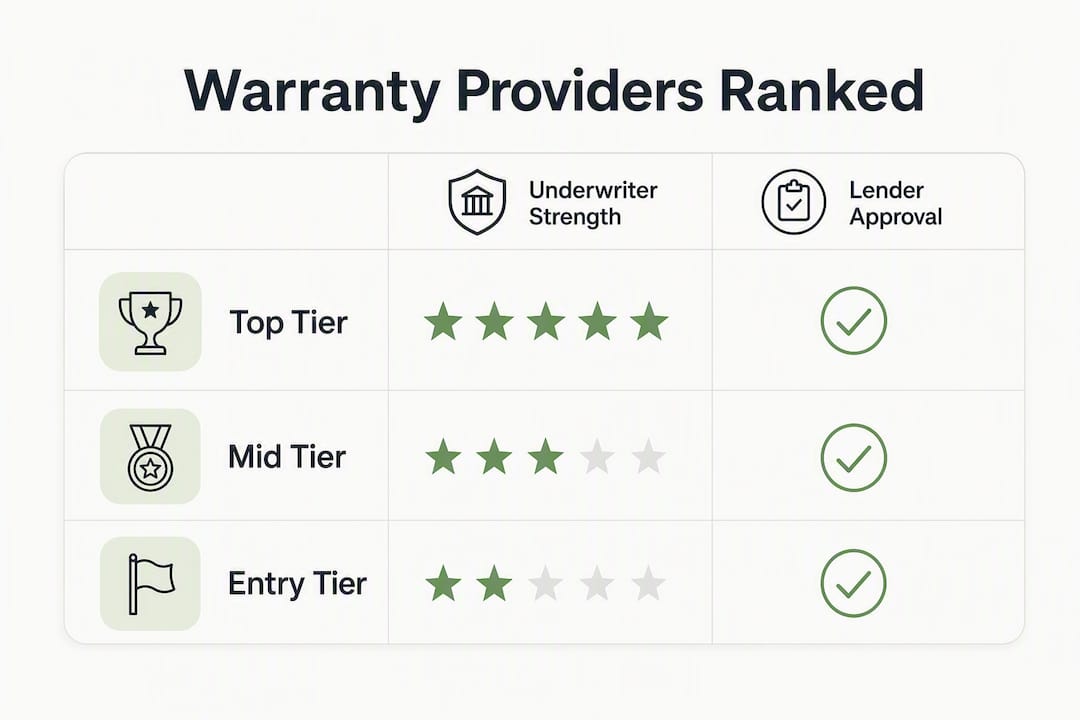
| Provider | Best for | Cover length & scope | Underwriter / financial strength | Lender acceptance | How price is calculated | Surveyor / audit model | Claims / service indicators |
|---|---|---|---|---|---|---|---|
| NHBC Buildmark | Volume housebuilders; large developments | 10 years (2-yr defects + 8-yr insurance) | NHBC is its own authorised insurer | Widest mainstream acceptance | Build cost / reinstatement value; structured fee scale | NHBC’s own inspectors; structured stage inspections | Established claims team; large case volume |
| LABC Warranty | Local-authority-aligned projects; social housing | 10 years; structural + defects | A-rated insurer backing | Widely accepted by mainstream lenders | Contract value and build type | Integrated with local authority building control | Strong technical audit record |
| Premier Guarantee | Mid-sized residential; apartments; mixed-use | 10 or 12 years depending on product | Established insurer relationships | Broadly accepted | Contract value; product line selected | Independent technical surveyors; stage inspections | Established provider; broad product range |
| Build-Zone | Self-builders; small regional developers | 10 years; structural latent defects | A-rated insurer backing | Accepted by most mainstream lenders | Contract value; build complexity | Independent surveyors; faster turnaround on smaller schemes | Known for speed and responsiveness |
| Protek | Bespoke homes; non-standard construction | 10 years; flexible policy options | A-rated insurer | Accepted by mainstream lenders | Build type; non-standard method risk | Independent surveyors | Flexible underwriting for unusual methods |
| ICW | Larger projects; housing associations | 10 years; latent defects | Established insurer capacity | Accepted by most lenders | Contract value; scheme size | Technical review team | Capacity for high-value placements |
| TMSC | Very large or complex mixed-use schemes | 10 years; specialist latent defects | Specialist insurer capacity | Accepted subject to scheme specifics | High-value contract pricing | In-house technical consultancy | Specialist handling for complex claims |
| BuildSafe | Developers wanting independent comparison | Advisory / comparison service | N/A (not an insurer) | N/A | N/A | N/A | Independent market commentary |
| Build Warranty | Smaller developments; self-build | 10 years; structural | A-rated insurer | Accepted by mainstream lenders | Contract value; scheme size | Independent surveyors | Practical option for lower-value schemes |
| Warranty Market | Anyone comparing providers independently | Comparison platform only | N/A | N/A | N/A | N/A | Aggregated verified customer metrics |
Provider-level notes:
NHBC Buildmark
- Largest market share; covers roughly 80% of newly built homes in the UK.
- Structured inspection pathway suits volume developers but can be slower and more costly on small or bespoke schemes.
- NHBC acts as its own insurer, which differs from providers that place risk with a third-party underwriter.
LABC Warranty
- Integrates building control with warranty inspection, reducing duplication on projects already using local authority building control.
- All LABC policies are underwritten by A-rated insurers, which satisfies lender requirements on underwriter strength.
- Particularly well suited to social-housing and affordable-housing schemes where local authority involvement is already mandated.
Premier Guarantee
- Offers both 10- and 12-year options, giving developers flexibility where a longer cover period adds commercial value.
- Broad product range covers standard residential, apartments, and mixed-use, making it a practical single-provider solution for varied portfolios.
- Check lender acceptance for specific apartment or mixed-use products, as some lenders apply additional conditions.
Build-Zone
- Independent providers such as Build-Zone frequently undercut NHBC on cost by around 20–30% on straightforward schemes and can be faster on approvals for smaller projects.
- Popular with self-builders and small regional developers who need a quick, cost-effective certificate.
- Lender acceptance is broad but always worth confirming for unusual scheme types.
Protek
- Specialist flexibility for non-standard construction methods, including timber frame, SIPs, and other modern methods of construction.
- Suitable for self-builders who cannot place risk with a provider requiring a conventional build method.
- Check the policy schedule carefully for any method-specific exclusions.
Profiles of the leading UK structural warranty providers

NHBC Buildmark

NHBC is the dominant force in UK new-home warranties, covering roughly 80% of newly built homes and recognised by every mainstream mortgage lender. Its structured inspection process and established claims infrastructure make it the path of least resistance for volume housebuilders. The trade-off is cost and pace: NHBC’s fee scale and inspection timetable are calibrated for large-scale production, which can make it a poor fit for a single self-build or a small bespoke scheme where an independent provider would move faster and charge less.
Best for: Volume housebuilders and large residential developments where lender familiarity is non-negotiable.
- Widest lender recognition in the UK market.
- NHBC acts as its own authorised insurer, so underwriter risk sits within NHBC itself.
- Structured process can be slower and more expensive on small or non-standard projects.
LABC Warranty
LABC Warranty integrates warranty inspection with local authority building control, which reduces duplication and can simplify the inspection schedule on projects already using an LABC-registered inspector. All policies carry A-rated insurer backing, satisfying lender requirements on underwriter strength. Social-housing and affordable-housing developers will find LABC Warranty particularly well aligned with their procurement frameworks.
Best for: Projects using local authority building control; social-housing and affordable-housing schemes.
- A-rated insurer backing on all policies.
- Integrated inspection reduces administrative duplication.
- Less commonly used on purely private-sector bespoke schemes.
Premier Guarantee
Premier Guarantee offers 10- and 12-year structural warranty options across residential, apartment, and mixed-use developments. Its breadth of product lines makes it a practical choice for developers managing varied portfolios, and its established insurer relationships give lenders confidence. The 12-year option is worth exploring where a longer cover period adds commercial value, for example on apartment schemes where buyers and their lenders may request it.
Best for: Mid-sized residential developments, apartment blocks, and mixed-use schemes needing a flexible product range.
- 10- and 12-year options available.
- Broad product range suits varied development portfolios.
- Confirm lender acceptance for specific mixed-use or apartment products before committing.
Build-Zone
Build-Zone has built a strong reputation among self-builders and small regional developers by combining competitive pricing with faster-than-average certificate turnaround. Independent providers such as Build-Zone frequently undercut NHBC on cost by around 20–30% on straightforward schemes, and their approval process is typically quicker for smaller projects. If your project is a single bespoke home or a small development of fewer than ten units, Build-Zone is worth obtaining a quote from alongside any larger provider.
Best for: Self-builders, bespoke homes, and small regional developers.
- Competitive pricing and faster turnaround on small-to-medium schemes.
- Accepted by most mainstream lenders.
- Less suited to very large or high-value placements where specialist capacity is needed.
Protek
Protek specialises in flexible coverage for non-standard construction methods, including timber frame, structural insulated panels (SIPs), and other modern methods of construction (MMC). Where a conventional provider declines or applies restrictive exclusions, Protek’s underwriting appetite often accommodates the build method. Self-builders using an architect-designed or engineer-specified non-standard structure should include Protek in their shortlist.
Best for: Bespoke homes and small developers using non-standard or modern construction methods.
- Flexible underwriting for MMC and non-standard methods.
- A-rated insurer backing.
- Policy schedule exclusions for specific methods should be read carefully before purchase.
ICW (International Construction Warranties)
ICW provides latent defects insurance across a wide range of contract values and is accepted by most mainstream lenders. Its capacity for larger placements makes it a credible option for housing associations and developers working on schemes above the threshold where smaller independents reach their indemnity limits. Confirm current indemnity limits and insurer appetite directly, as market capacity for large-value placements has shifted and developers should verify availability for high-value schemes.
Best for: Larger projects and housing-association placements.
- Capacity for higher contract values.
- Accepted by most mainstream lenders.
- Confirm current indemnity limits for very large schemes.
Thomas Miller Specialty Construction (TMSC)
TMSC operates at the specialist end of the market, providing latent defects insurance and risk solutions for large commercial or high-value residential schemes. Its in-house technical consultancy is a genuine differentiator for complex mixed-use projects where standard providers lack the underwriting appetite or technical resource to assess risk accurately. For most residential developers, TMSC is not the first call; for a high-value, complex scheme, it may be the only credible option.
Best for: Very large projects and complex mixed-use schemes over significant contract values.
- Specialist insurer capacity for high-value placements.
- In-house technical consultancy for complex risk assessment.
- Not suited to standard residential or small-scale projects.
BuildSafe
BuildSafe is an independent comparison and advisory resource rather than a warranty provider. It publishes market analysis comparing NHBC, LABC, Build-Zone, and others, and its commentary is useful for developers who want an independent view before approaching providers directly. BuildSafe does not sell warranties, so its analysis carries no commercial bias towards a particular product.
Best for: Developers wanting independent side-by-side market analysis before approaching providers.
- Independent commentary with no product sales bias.
- Useful for understanding cost and service differences between providers.
- Not a warranty provider; cannot issue certificates.
Build Warranty
Build Warranty is a recognised warranty brand used on smaller developments and self-build projects. It offers a practical, straightforward route to a 10-year structural warranty certificate for lower-value or uncomplicated schemes. For a developer or self-builder whose project does not require specialist capacity or a complex product structure, Build Warranty provides a workable and lender-accepted option.
Best for: Smaller developments and self-builders with straightforward schemes.
- Practical option for lower-value projects.
- Accepted by mainstream lenders.
- Limited public profile on specialist or high-value placements.
Warranty Market
Warranty Market is a dedicated UK structural warranty comparison platform that aggregates verified customer feedback and service performance metrics across providers. It does not sell warranties. Its value lies in giving developers and buyers an independent view of how providers perform on service, response times, and claims handling, rather than on headline cover terms alone.
Best for: Anyone wanting an independent, data-driven comparison of provider service metrics and customer reviews.
- Aggregates verified customer feedback across the market.
- No commercial relationship with any provider.
- A useful cross-check before committing to a provider shortlist.
How do you choose the right structural warranty provider?
Three checks resolve most decisions: confirm lender acceptance, verify A-rated underwriter backing, and read the policy scope to understand what is structural insurance and what is the developer’s defects obligation.
The decision flow runs in this order. Start with your project type, because that determines which providers have the appetite and the product to cover it. A volume housebuilder has different needs from a self-builder using a timber-frame system, and a housing association procurement framework may mandate or restrict certain providers. Once you have a shortlist of providers that fit your project type, apply the lender constraint: check the UK Finance mortgage lenders handbook and confirm in writing with your intended lender that the warranty is acceptable. Then assess underwriter strength, because a policy’s real protection hinges on the insurer’s rating; if the provider changes distribution partners or ceases operation, responsibility falls to the underwriter. Finally, compare cost and timeline, because on a small scheme the difference between providers can be material.
Red flags to watch for:
- An underwriter with no published credit rating or a rating below A.
- Policy wording that is vague about what constitutes a “structural defect” versus a “cosmetic defect.”
- Certificate lead times that would delay your practical completion or mortgage drawdown.
- A funding body or housing association that mandates a specific provider, which may block a cheaper or faster alternative.
- Providers who cannot supply a sample policy schedule on request.
When to use an independent broker or adviser: complex projects, large contract values, non-standard build methods, and any scheme where you are unsure whether your chosen provider has the appetite or indemnity capacity. Ask the adviser for turnaround times on comparable recent schemes, sample policy wording, and at least one claims example. The role of inspections in the build process is also worth understanding before you engage a provider, as the surveyor model varies significantly between NHBC and independent providers.
Pro Tip: Request a pre-application technical call with your shortlisted provider before submitting formal documentation. Identifying any ground-risk, structural-design, or build-method concerns at that stage costs nothing and can prevent weeks of delay later.
What do structural warranties cost and how long does approval take?
Price is driven by reinstatement value (or contract value on new builds), build method, ground risk, project complexity, and the number of units. There is no single published tariff across the market, but the cost differential between providers is real: independent providers frequently undercut NHBC by around 20–30% on straightforward schemes, which on a £400,000 contract value translates to a meaningful saving. Non-standard construction methods, contaminated land, or complex structural engineering will attract higher premiums from any provider.
The typical timeline from application to certificate issue runs as follows:
- Application and documentation submission. Submit structural drawings, specification, ground investigation report, and planning consent. Incomplete submissions are the single most common cause of delay.
- Technical review. The provider’s technical team assesses the design and ground conditions. Straightforward schemes: one to two weeks. Complex or non-standard schemes: three to six weeks or longer.
- Stage inspections. Surveyors attend at agreed build stages (foundations, superstructure, weathertight, pre-completion). Scheduling delays on site directly extend the timeline.
- Certificate issue. Once all inspections are satisfactory and any technical queries resolved, the certificate is issued. On a straightforward scheme, the full process from application to certificate can take eight to twelve weeks; complex projects routinely take longer.
Registration fees and survey fees are charged separately by most providers. Some providers charge a non-refundable registration fee at application stage; survey fees are typically invoiced as inspections are completed. Confirm the fee structure in writing before you register, particularly on schemes where the build programme may extend beyond original estimates.
Pro Tip: Prepare a complete documentation pack before approaching any provider: structural engineer’s drawings and calculations, ground investigation report, planning consent, and a clear reinstatement valuation. Providers who receive complete submissions at the outset consistently issue certificates faster than those who spend weeks chasing missing documents.
For self-builders, a custom home building checklist can help you organise the documentation a warranty provider will need before you even make first contact.
How do you verify lender acceptance and underwriter strength?
Lender acceptance and underwriter strength are two separate checks, and both matter. A warranty accepted by your lender today may still leave you exposed if the insurer behind it is financially weak.
Checking lender acceptance:
- Consult the UK Finance mortgage lenders handbook, which lists accepted warranty providers by name. Different lenders may apply additional conditions for specific scheme types such as Help to Buy, shared ownership, or apartment conversions.
- Ask your lender for written confirmation that the specific warranty product (not just the provider brand) is acceptable for your scheme.
- Check the provider’s own lender acceptance list on their website, but treat it as a starting point rather than a definitive answer; lender policies change.
- All major UK warranty providers are accepted by mainstream mortgage lenders and are listed within the UK Finance lenders handbook, but acceptance breadth can vary by lender and scheme type.
Checking the underwriter:
- The underwriter’s name and credit rating appear in the policy schedule or the provider’s FAQs. If they do not, ask for them in writing before purchasing.
- Look for an A-rated insurer from a recognised rating agency. Developers should prioritise policies backed by an A-rated insurer because the insurer’s strength determines long-term protection if a provider exits the market.
- Understand the distinction between provider risk and underwriter risk. If the warranty brand ceases trading, the insurer remains liable for valid claims for the remainder of the policy term. A provider exit is disruptive but not catastrophic if the underwriter is financially sound. An underwriter insolvency, by contrast, can leave policyholders without recourse.
The building regulations approval process intersects with warranty inspections at several stages, and understanding where building control ends and warranty inspection begins will help you avoid gaps in your technical audit trail.
What does claiming on a structural warranty actually involve?
The claims process follows a broadly consistent pattern across providers, though response times and resolution quality vary considerably.
Typical claims flow:
- Notify the provider in writing as soon as a defect is identified, with photographic evidence and a description of the issue.
- The provider arranges a technical assessment, usually by an independent surveyor or their own technical team.
- If the defect falls within the policy scope, the provider either funds remediation directly or requires the developer to carry out works and reimburses costs.
- Disputes about whether a defect is structural or cosmetic are the most common source of delay; clear maintenance records and inspection reports from the build stage materially improve your position.
Common exclusions to understand before you buy:
- Cosmetic defects and normal wear and tear are excluded from structural insurance cover across all providers.
- Maintenance-related issues, such as blocked gutters causing water ingress, are typically excluded.
- The first two years of a 10-year warranty are usually the developer’s defects period, during which the developer (not the insurer) is responsible for rectifying defects. Years 3–10 are structural insurance; years 1–2 are a contractual obligation on the developer.
- Settlement and shrinkage within normal tolerances are commonly excluded.
Service metrics to check when comparing providers:
Claims handling quality is difficult to assess from marketing materials alone. Warranty Market aggregates verified customer feedback and service performance metrics, making it a useful independent cross-check. Trustpilot profiles exist for several providers, including Protek, ICW, and Build-Zone, and reading recent reviews gives a realistic picture of how providers handle claims and respond to queries. Surveyor response times, average claim resolution periods, and the availability of a dedicated claims handler are the metrics that matter most in practice.
Transferability and resale impact: Structural warranties transfer automatically to subsequent owners for the remainder of the policy term. This is a material selling point at resale: a property with a live 10-year warranty certificate is demonstrably easier to mortgage and sell than one without. Buyers and their solicitors will ask for the certificate as a matter of course, so keep it with the property deeds.
Why underwriter strength and lender lists determine who is actually “best”
The most important insight in this comparison is one that marketing materials rarely state plainly: there is no single best provider for every project. Selection should be driven by project type, lender constraints, and underwriter strength. Brand recognition alone is insufficient.
Market dynamics reinforce this. Providers enter and exit the market, insurer capacity shifts, and indemnity limits change. As of 2026, some new entrants and insurer capacity shifts have altered market availability for large-value placements, meaning developers on high-value schemes should confirm indemnity limits and insurer appetite before assuming a familiar provider can accommodate their scheme.
“Independent comparison tools and specialist advisers add value for developers because they can match provider appetite to project specifics and negotiate capacity where needed. Check the insurer backing the policy, not just the warranty brand — A-rated insurer backing is often the decisive factor for long-term security.”
Warranty Market
For straightforward residential schemes, the choice between NHBC and a well-rated independent is largely a cost and timeline decision. For complex, large-value, or non-standard projects, the question of which provider has the appetite and capacity to cover the scheme is more pressing than any comparison of headline cover terms. An independent comparison platform such as Warranty Market or an advisory service such as BuildSafe can help match provider appetite to project specifics, particularly where the build method or contract value sits outside the mainstream.
Key takeaways
The single most important decision in choosing a UK structural warranty is confirming that the insurer behind the policy carries an A-rated credit rating, because that underwriter, not the warranty brand, is your long-term protection.
| Point | Details |
|---|---|
| Verify lender acceptance first | Check the UK Finance mortgage lenders handbook and get written confirmation from your lender before committing to a provider. |
| A-rated underwriter is non-negotiable | The insurer behind the policy carries the long-term risk; if the provider exits the market, the underwriter remains liable. |
| Independent providers can save 20–30% | On straightforward schemes, Build-Zone and similar independents frequently undercut NHBC on cost and approval time. |
| Warranties transfer to new owners | A live structural warranty certificate transfers automatically and materially supports resale and mortgage applications. |
| Ajcandsonbuilders can assist | For renovations and smaller developments in Liverpool and Merseyside, Ajcandsonbuilders helps prepare technical documentation and coordinate surveyor access to support your warranty application. |
A builder’s perspective on getting the warranty right
The part of the warranty process where time and money are most often lost is not the choice of provider. It is the preparation that comes before the application lands on the provider’s desk.
From our experience working on residential projects across Liverpool and Merseyside, the most common cause of delayed certificates is incomplete documentation at submission: missing ground investigation reports, structural calculations that do not match the drawings, or reinstatement valuations that have not been updated since the original planning application. Providers cannot begin their technical review until the submission is complete, and every week spent chasing missing documents is a week added to the programme.
The second most common issue is underestimating the reinstatement value. An accurate reinstatement valuation matters because the premium is calculated against it, and an undervalued submission can leave the policy inadequately funded if a major structural claim arises. We recommend obtaining a formal reinstatement valuation from a chartered surveyor rather than using a rule-of-thumb estimate.
Our caution to any developer or self-builder: do not choose a warranty provider on brand recognition alone. We have seen projects where a well-known provider name gave false confidence, only for the buyer’s solicitor to identify that the specific product was not accepted by the buyer’s lender. Checking the lender list and the underwriter rating takes thirty minutes and prevents that problem entirely.
How Ajcandsonbuilders helps you manage the warranty process
Choosing the right warranty provider is only half the work. The other half is ensuring your project meets the technical requirements that allow the warranty to be issued without delays or additional cost.
Ajcandsonbuilders works with homeowners, self-builders, and small developers across Liverpool and Merseyside on renovation and extension projects where a structural warranty or latent defects certificate is required. We help prepare the technical documentation that warranty providers need at application stage: structural drawings, specification notes, reinstatement valuations, and build-stage records. We also coordinate surveyor access at each inspection stage, which keeps the build programme on track and avoids the certificate delays that come from missed or rescheduled inspections.
For smaller developments and renovation projects, the difference between a smooth warranty application and a protracted one often comes down to having a builder who understands what the provider’s technical team is looking for. If you are planning a project in Liverpool or Merseyside and want practical guidance on the warranty process alongside the build itself, get in touch with our team for a no-obligation conversation about your project.
Authoritative sources and next steps
Use these resources to verify lender acceptance, check underwriter ratings, and read independent provider comparisons before committing to a warranty product.
- UK Finance mortgage lenders handbook — the definitive reference for which warranty providers are accepted by which lenders, and any scheme-specific conditions that apply.
- LABC Warranty — confirms A-rated insurer backing, product scope, and the integration with local authority building control.
- Warranty Market — independent UK comparison platform aggregating verified customer feedback and service metrics; no commercial relationship with any provider.
- J3 Advisory: new build 10-year warranty providers compared — market-share estimates, underwriter guidance, and capacity notes for large-value placements.
- Trustpilot profiles for Protek, ICW, and Build-Zone — independent customer reviews covering claims handling and service responsiveness.
- Ajcandsonbuilders building services — for local help with documentation, surveyor coordination, and warranty-ready build management across Liverpool and Merseyside.
This article provides general information about UK structural warranty providers and is not a substitute for professional advice. Warranty terms, lender acceptance lists, and insurer ratings change; always confirm current details directly with the provider, your mortgage lender, and a qualified adviser before purchasing a policy.